تم الحل ✓
categoryرياضيات
schoolبكالوريوس
event_available2026-07-13
السؤال
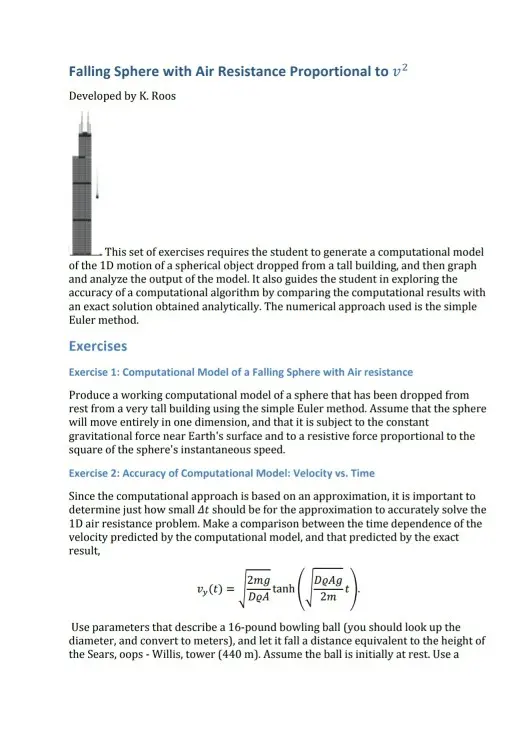
Transcribed Image Text:
Falling Sphere with Air Resistance Proportional to v²
Developed by K. Roos
This set of exercises requires the student to generate a computational model
of the 1D motion of a spherical object dropped from a tall building, and then graph
and analyze the output of the model. It also guides the student in exploring the
accuracy of a computational algorithm by comparing the computational results with
an exact solution obtained analytically. The numerical approach used is the simple
Euler method.
Exercises
Exercise 1: Computational Model of a Falling Sphere with Air resistance
Produce a working computational model of a sphere that has been dropped from
rest from a very tall building using the simple Euler method. Assume that the sphere
will move entirely in one dimension, and that it is subject to the constant
gravitational force near Earth's surface and to a resistive force proportional to the
square of the sphere's instantaneous speed.
Exercise 2: Accuracy of Computational Model: Velocity vs. Time
Since the computational approach is based on an approximation, it is important to
determine just how small At should be for the approximation to accurately solve the
1D air resistance problem. Make a comparison between the time dependence of the
velocity predicted by the computational model, and that predicted by the exact
result,
2mg tanh
vy(t)= DoA
DoAg
2m
Use parameters that describe a 16-pound bowling ball (you should look up the
diameter, and convert to meters), and let it fall a distance equivalent to the height of
the Sears, oops - Willis, tower (440 m). Assume the ball is initially at rest. Use a
value of 0.5 for the drag coefficient, and the density of air near sea level. What value
of At do you deem to be sufficiently small for the computational model to be
accurate? Explain how you arrived at this value of At.
Exercise 3: Accuracy of Computational Model: Position vs. Time
Carry out the same comparison (computational vs. exact analytical solution) for the
bowling ball's position as a function of time. The exact result for the ball's position is
given by
2m
In cosh
DoAg
2m
y(t) = DQA
Assume the bowling ball is falling the same distance of 440 m. Do you find the same
value of At, as found for the velocity comparison of Exercise 2, to be acceptable for
the position comparison?
Exercise 4: Position and Velocity of Dropped Bowling Ball
Produce plots of the bowling ball's velocity and vertical position as functions of time
from the results of the computational model, using the parameters from the
previous exercises and the value of At (determined in Exercises 2 and 3) that
produces a tolerably accurate computational solution. Has the bowling ball reached
its terminal velocity by the time it hits the ground? Use your model to predict the
time required for the bowling ball to fall the full 440 meters to the ground.
Exercise 5: Position and Velocity of Dropped Basketball
Repeat Exercise 3 using the parameters for a basketball in your model (you will
have to be resourceful and look up the weight and diameter of a typical basketball).
How does the behavior of the basketball compare to that of the bowling ball?
Exercise 6: Position and Velocity of Dropped Baseball
Repeat Exercise 3 using the parameters for a baseball (again, look up the relevant
parameters). How does the behavior of the baseball compare to that of the bowling
ball and basketball?
Exercise 7: Assessing Computational Accuracy in the Absence of an Analytical Solution
In practice, computational models are produced to describe the dynamics of
systems for which an exact analytical solution is very likely unknown. Based on your
observations of the behavior of the model as At gets smaller, can you suggest a
procedure that could be used to assess the accuracy of a computational model in the
event that you have no analytical curve with which to compare the computational
result? Be very detailed in describing the procedure.
check_circle الجواب — حل مفصل خطوة بخطوة
hourglass_top
🔒
الحل الكامل متاح للمشتركين
اشترك في أرشيف الأسئلة لعرض هذا الحل وآلاف الحلول المفصلة خطوة بخطوة من معلمين معتمدين.