تم الحل ✓
categoryعلوم الحاسوب
schoolبكالوريوس
event_available2026-07-13
السؤال
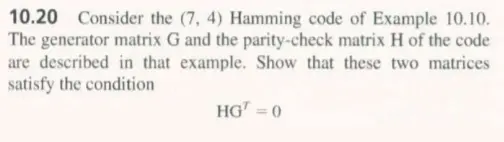
Transcribed Image Text:
10.20 Consider the (7, 4) Hamming code of Example 10.10.
The generator matrix G and the parity-check matrix H of the code
are described in that example. Show that these two matrices
satisfy the condition
HGT=0
EXAMPLE 10.10 Hamming Codes
Consider a family of (n,k) linear block codes that have the following
parameters:
Block length:
Number of message bits:
Number of parity bits:
n-2-1
k=2"-m-1
n-k=m
where m ≥3. These are the so-called Hamming codes.
Consider, for example, the (7, 4) Hamming code with n = 7 and k = 4,
corresponding to m = 3. The generator matrix of the code must have a struc-
ture that conforms to Eq. (10.73). The following matrix represents an appro-
priate generator matrix for the (7, 4) Hamming code.
G=
1 1 0 1 0 0 0]
01 10 100
1110010
1010001
P
I
The corresponding parity-check matrix is given by
H=
[1 0 0|1 0 1
01 0 1 1 1 0
0010111
Im-k
PT
With k 4, there are 2 = 16 distinct message words, which are listed
in Table 10.4. For a given message word, the corresponding codeword is ob-
tained by using Eq. (10.74). Thus, the application of this equation results in
the 16 codewords listed in Table 10.4.
=
In Table 10.4 we have also listed the Hamming weights of the individual
codewords in the (7, 4) Hamming code. Since the smallest of the Hamming
weights for the nonzero codewords is 3, it follows that the minimum distance of
the code is 3. Indeed, Hamming codes have the property that the minimum dis-
tance dmin 3, independent of the value assigned to the number of parity bits m.
To illustrate the relation between the minimum distance dmin and the
structure of the parity-check matrix H, consider the codeword 0110100. In
the matrix multiplication defined by Eq. (10.77), the nonzero elements of this
TABLE 10.4 Codewords of a (7, 4) Hamming code
376
Message
Word
Codeword
Weight of
Codeword
Message
Weight of
Word
Codeword
Codeword
0000
0000000
0
1000
1101000
3
0001
1010001
3
1001
0111001
4
0010
1110010
4
1010
0011010
3
0011
0100011
3
1011
1001011
0100
0110100
3
1100
1011100
0101
1100101
4
1101
0001101
0110
1000110
3
1110
0111
0010111
4
1111
0101110
1111111
44347
codeword sift out the second, third, and fifth columns of the matrix H
yielding
8-8-8-8
We may perform similar calculations for the remaining 14 nonzero code-
words. We thus find that the smallest number of columns in H that sums
to zero is 3, confirming the earlier statement that dmin = 3.
An important property of Hamming codes is that they satisfy the con-
dition Eq. (10.86) with the equality sign, assuming that = 1. This means
that Hamming codes are single-error correcting binary perfect codes.
Assuming single-error patterns, we may formulate the seven coset
leaders listed in the right-hand column of Table 10.5. The corresponding
syndromes, listed in the left-hand column, are calculated in accordance
with Eq. (10.81). The zero syndrome signifies no transmission errors.
Suppose, for example, the code vector [1110010] is sent, and the
received vector is [1100010] with an error in the third bit. Using
Eq. (10.80), the syndrome is calculated to be
[1 0 0]
010
001
s=[1100010] 1 1 0
=[001]
0
From Table 10.5 the corresponding coset leader (i.e., error pattern with
the highest probability of occurrence) is found to be [0010000], indicating
correctly that the third bit of the received vector is erroneous. Thus, adding
this error pattern to the received vector, in accordance with Eq. (10.87),
yields the correct code vector actually sent.
Richard W. Hamming (1915-1998)
When Richard W. Hamming joined Bell
Laboratories, he shared an office with
Claude Shannon. While Shannon worked
on information theory, Hamming worked
on coding theory at the same time and in
the same place.
In an interview taped in 1977, just
about three decades after the discovery of
the first binary codes, Hamming recalled
his frustration working on a mechanical re-
lay computer, to which he had access only
on weekends: "Two weekends in a row I
came in and found that all my stuff had
been dumped and nothing was done... And
so I said: "Damn it, if the machine can detect
an error, why can't it locate the position of
the error and correct it?" It was that question
that led to the discovery of the first binary
error-correcting codes by Hamming.
The history of the origin of coding
theory has a controversy of its own. The
publication of Hamming's paper in the Bell
System Technical Journal in 1949 was held
up for some time due to patent reasons.
In that same year, Golay published a paper
in the Proceedings of the IRE (later re-
named the IEEE), in which his (23,12) and
(11,6) codes were described. For an inter-
esting exposé of how this controversy
played out, see the last section of Chapter 1
of Thompson's book (1983).
Dual Code. Given a linear block code, we may define its dual as follows.
Taking the transpose of both sides of Eq. (10.76), we have
GHT=0
where H is the Transpose of the parity-check matrix of the code, and 0 is a new zero
matrix. This equation suggests that every (n.k) linear block code with generator
matrix G and parity-check matrix H has a dual code with parameters (n, n-
erator matrix H and parity-check matrix G.
TABLE 10.5 Decoding table for the
(7,4) Hamming code
defined in Table 10.4
Syndrome
Error Pattern
0000000
k), gen-
000
100
1000000
010
0100000
CYCLIC CODES
001
0010000
The set of linear block codes is large. One important subclass of linear block codes is
known as cyclic codes, as they are characterized by the fact that any cyclic shift a
codeword is also a codeword. Important examples of cyclic codes are:
110
0001000
011
0000100
111
0000010
101
0000001
Hamming codes, of which we have already given an example.
377
check_circle الجواب — حل مفصل خطوة بخطوة
hourglass_top
🔒
الحل الكامل متاح للمشتركين
اشترك في أرشيف الأسئلة لعرض هذا الحل وآلاف الحلول المفصلة خطوة بخطوة من معلمين معتمدين.