تم الحل ✓
categoryهندسة حاسوب وشبكات
schoolبكالوريوس
event_available2026-07-13
السؤال
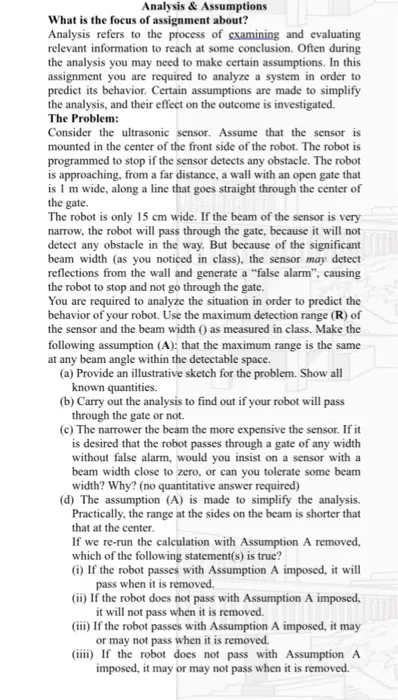
Transcribed Image Text:
Analysis & Assumptions
What is the focus of assignment about?
Analysis refers to the process of examining and evaluating
relevant information to reach at some conclusion. Often during
the analysis you may need to make certain assumptions. In this
assignment you are required to analyze a system in order to
predict its behavior. Certain assumptions are made to simplify
the analysis, and their effect on the outcome is investigated.
The Problem:
Consider the ultrasonic sensor. Assume that the sensor is
mounted in the center of the front side of the robot. The robot is
programmed to stop if the sensor detects any obstacle. The robot
is approaching, from a far distance, a wall with an open gate that
is I m wide, along a line that goes straight through the center of
the gate.
The robot is only 15 cm wide. If the beam of the sensor is very
narrow, the robot will pass through the gate, because it will not
detect any obstacle in the way. But because of the significant
beam width (as you noticed in class), the sensor may detect
reflections from the wall and generate a "false alarm", causing
the robot to stop and not go through the gate.
You are required to analyze the situation in order to predict the
behavior of your robot. Use the maximum detection range (R) of
the sensor and the beam width () as measured in class. Make the
following assumption (A): that the maximum range is the same
at any beam angle within the detectable space.
(a) Provide an illustrative sketch for the problem. Show all
known quantities.
(b) Carry out the analysis to find out if your robot will pass
through the gate or not.
(c) The narrower the beam the more expensive the sensor. If it
is desired that the robot passes through a gate of any width
without false alarm, would you insist on a sensor with a
beam width close to zero, or can you tolerate some beam
width? Why? (no quantitative answer required)
(d) The assumption (A) is made to simplify the analysis.
Practically, the range at the sides on the beam is shorter that
that at the center.
If we re-run the calculation with Assumption A removed,
which of the following statement(s) is true?
(i) If the robot passes with Assumption A imposed, it will
pass when it is removed.
(ii) If the robot does not pass with Assumption A imposed,
it will not pass when it is removed.
(iii) If the robot passes with Assumption A imposed, it may
or may not pass when it is removed.
(iii) If the robot does not pass with Assumption A
imposed, it may or may not pass when it is removed.
check_circle الجواب — حل مفصل خطوة بخطوة
hourglass_top
🔒
الحل الكامل متاح للمشتركين
اشترك في أرشيف الأسئلة لعرض هذا الحل وآلاف الحلول المفصلة خطوة بخطوة من معلمين معتمدين.