تم الحل ✓
categoryهندسة كهربائية
schoolبكالوريوس
event_available2026-07-13
السؤال
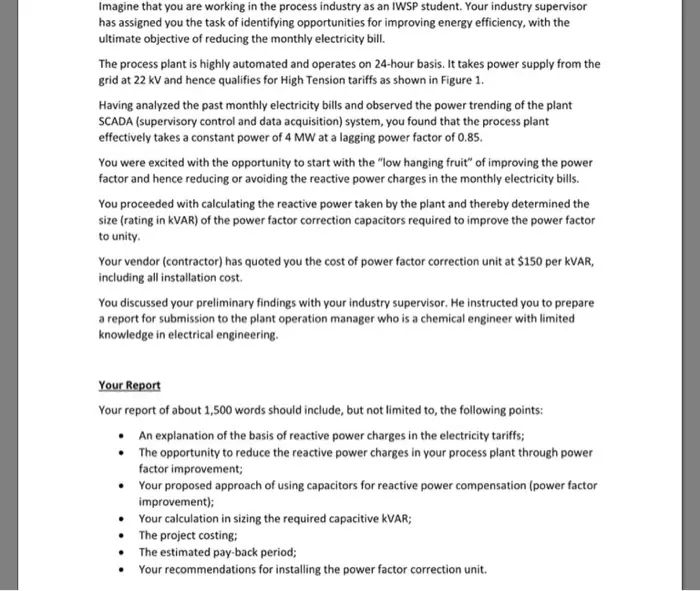
Transcribed Image Text:
Imagine that you are working in the process industry as an IWSP student. Your industry supervisor
has assigned you the task of identifying opportunities for improving energy efficiency, with the
ultimate objective of reducing the monthly electricity bill.
The process plant is highly automated and operates on 24-hour basis. It takes power supply from the
grid at 22 kV and hence qualifies for High Tension tariffs as shown in Figure 1.
Having analyzed the past monthly electricity bills and observed the power trending of the plant
SCADA (supervisory control and data acquisition) system, you found that the process plant
effectively takes a constant power of 4 MW at a lagging power factor of 0.85.
You were excited with the opportunity to start with the "low hanging fruit" of improving the power
factor and hence reducing or avoiding the reactive power charges in the monthly electricity bills.
You proceeded with calculating the reactive power taken by the plant and thereby determined the
size (rating in KVAR) of the power factor correction capacitors required to improve the power factor
to unity.
Your vendor (contractor) has quoted you the cost of power factor correction unit at $150 per KVAR,
including all installation cost.
You discussed your preliminary findings with your industry supervisor. He instructed you to prepare
a report for submission to the plant operation manager who is a chemical engineer with limited
knowledge in electrical engineering.
Your Report
Your report of about 1,500 words should include, but not limited to, the following points:
An explanation of the basis of reactive power charges in the electricity tariffs;
The opportunity to reduce the reactive power charges in your process plant through power
factor improvement;
• Your proposed approach of using capacitors for reactive power compensation (power factor
improvement);
•
Your calculation in sizing the required capacitive KVAR;
The project costing;
The estimated pay-back period;
Your recommendations for installing the power factor correction unit.
ELECTRICITY TARIFFS FROM 1 OCTOBER 2017
Existing Tariff
(without GST)
New Tariff
(without GST)
New Tariff
[with 7% GST)
LOW TENSION SUPPLIES, DOMESTIC
20.72
20.30
21.72
All units, c/kwh
LOW TENSION SUPPLIES, NON-DOMESTIC
20.72
20.30
21.72
All units, c/kwh
HIGH TENSION SMALL (HTS) SUPPLIES
Contracted Capacity Charge
8.36
8.36
8.95
S/kw/month
Uncontracted Capacity Charge
S/chargeable kw/month
12.54
12.54
13.42
kwh charge, c/kWh
Peak period (7.00am to 11.00pm]
17.94
17.47
18.69
Off-peak period (11.00pm to 7.00am
10.84
10.55
11.29
Reactive power Charge
c/chargeable kVARh
0.59
0.59
0.63
HIGH TENSION LARGE (HTL) SUPPLIES
Contracted Capacity Charge
8.36
8.36
8.95
S/kw/month
Uncontracted Capacity Charge
12.54
12.54
13.42
S/chargeable kw/month
kwh charge, c/kwh
Peak period 17.00am to 11.00pm]
17.72
17.25
18.46
Off-peak period [11.00pm to 7.00am)
10.63
10.54
11.28
Reactive power Charge
0.59
0.59
0.63
c/chargeable kVARh
EXTRA HIGH TENSION (EHT) SUPPLIES
Contracted Capacity Charge
7.54
7.54
8.07
S/kw/month
Uncontracted Capacity Charge
11.31
11.31
12.10
S/chargeable kw/month
kwh charge, c/kWh
Peak period (7.00am to 11.00pm]
Off-peak period [11.00pm to 7.00am)
Reactive power Charge
c/chargeable kVARh
16.84
16.38
17.53
10.74
10.45
1118
0.48
0.48
0.51
Figure 1-Electricity Tariffs
check_circle الجواب — حل مفصل خطوة بخطوة
hourglass_top
🔒
الحل الكامل متاح للمشتركين
اشترك في أرشيف الأسئلة لعرض هذا الحل وآلاف الحلول المفصلة خطوة بخطوة من معلمين معتمدين.