تم الحل ✓
categoryهندسة كيميائية
schoolبكالوريوس
event_available2026-07-13
السؤال
Transcribed Image Text:
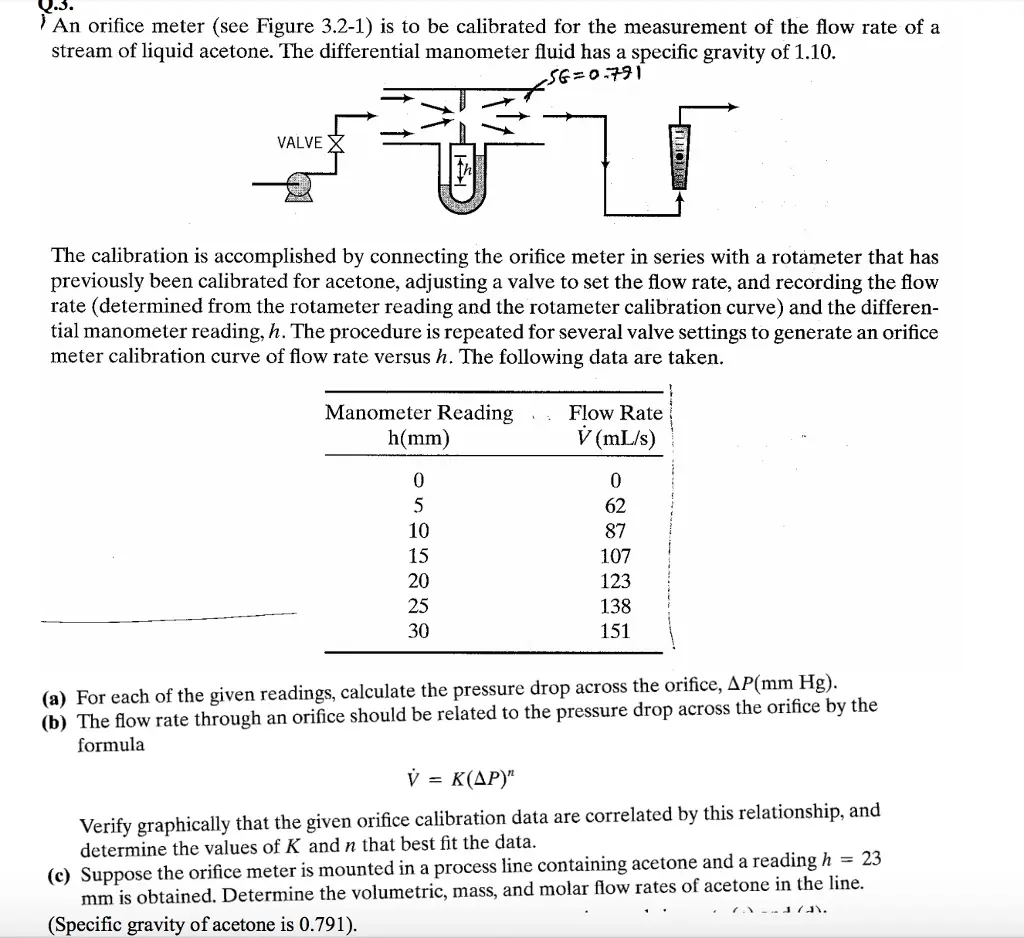
› An orifice meter (see Figure 3.2-1) is to be calibrated for the measurement of the flow rate of a
stream of liquid acetone. The differential manometer fluid has a specific gravity of 1.10.
VALVE
-56=0.791
The calibration is accomplished by connecting the orifice meter in series with a rotameter that has
previously been calibrated for acetone, adjusting a valve to set the flow rate, and recording the flow
rate (determined from the rotameter reading and the rotameter calibration curve) and the differen-
tial manometer reading, h. The procedure is repeated for several valve settings to generate an orifice
meter calibration curve of flow rate versus h. The following data are taken.
Manometer Reading
h(mm)
Flow Rate
V (mL/s)
0
0
5
62
10
87
15
107
20
123
25
138
30
151
(a) For each of the given readings, calculate the pressure drop across the orifice, AP(mm Hg).
(b) The flow rate through an orifice should be related to the pressure drop across the orifice by the
formula
V = K(AP)"
Verify graphically that the given orifice calibration data are correlated by this relationship, and
determine the values of K and n that best fit the data.
(c) Suppose the orifice meter is mounted in a process line containing acetone and a reading h = 23
mm is obtained. Determine the volumetric, mass, and molar flow rates of acetone in the line.
(Specific gravity of acetone is 0.791).
check_circle الجواب — حل مفصل خطوة بخطوة
hourglass_top
🔒
الحل الكامل متاح للمشتركين
اشترك في أرشيف الأسئلة لعرض هذا الحل وآلاف الحلول المفصلة خطوة بخطوة من معلمين معتمدين.