تم الحل ✓
categoryبرمجة وتطوير البرمجيات
schoolبكالوريوس
event_available2026-07-13
السؤال
Transcribed Image Text:
1. The Sieve of Eratosthen
A prime integer is any integer that can be divided evenly only by itself and 1. The Sieve
of Eratosthenes is a method of finding prime numbers. It works as follows:
a) Create an array with all elements initialized to 1 (true). Array elements with prime subscripts will
remain 1. All other array elements will eventually be set to zero.
b) Starting with array subscript 2, every time an array element is found whose value is 1, loop through
the remainder of the array and set to zero every element whose subscript is a multiple of the subscript
for the element with value 1. For array subscript 2, all elements beyond 2 in the array that are
multiples of 2 will be set to zero (subscripts 4, 6, 8, 10, etc.). For array subscript 3, all elements
beyond 3 in the array that are multiples of 3 will be set to zero (subscripts 6, 9, 12, 15, etc.).
When this process is complete, the array elements that are still set to one indicate that
the subscript is a prime number. These subscripts can then be printed. Write a program
that uses an array of 1000 elements to determine and print the prime numbers between
1 and 999. Ignore elements 0 and 1 of the array. Determine the prime numbers using
functions and print the resulting array in the main program.
Note: Use only pointer offset notation to perform this task.
***NOTE: You are requested to submit two programs:
1. Write the program using recursive functions
2. Write the program using non-recursive functions
2. Blob Counter:
We have a two-dimensional grid of cells, each of which may be empty or filled. The
filled cells that are connected form a "blob". There may be several blobs on the grid.
Write a recursive function that accepts as input the indices of a particular cell and
returns the size of the blob containing the cell.
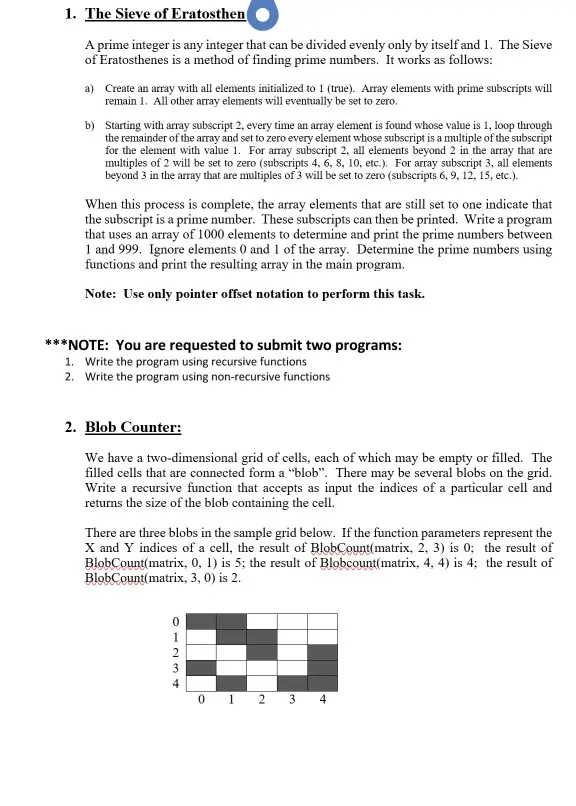
There are three blobs in the sample grid below. If the function parameters represent the
X and Y indices of a cell, the result of BlobCount(matrix, 2, 3) is 0; the result of
BlobCount(matrix, 0, 1) is 5; the result of Blobcount(matrix, 4, 4) is 4; the result of
BlobCount(matrix, 3, 0) is 2.
0123 T
0 1 2 3
4
check_circle الجواب — حل مفصل خطوة بخطوة
hourglass_top
🔒
الحل الكامل متاح للمشتركين
اشترك في أرشيف الأسئلة لعرض هذا الحل وآلاف الحلول المفصلة خطوة بخطوة من معلمين معتمدين.