تم الحل ✓
categoryهندسة مدنية
schoolبكالوريوس
event_available2026-07-13
السؤال
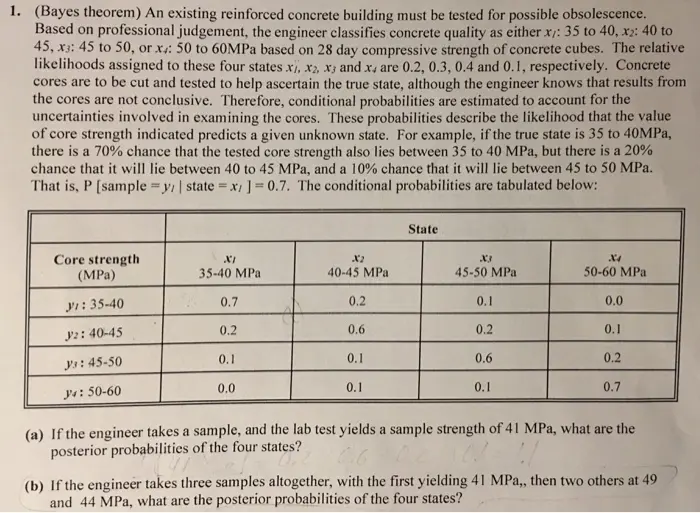
Transcribed Image Text:
1. (Bayes theorem) An existing reinforced concrete building must be tested for possible obsolescence.
Based on professional judgement, the engineer classifies concrete quality as either x: 35 to 40, x2: 40 to
45, x3: 45 to 50, or x: 50 to 60MPa based on 28 day compressive strength of concrete cubes. The relative
likelihoods assigned to these four states x1, x2, x3 and x are 0.2, 0.3, 0.4 and 0.1, respectively. Concrete
cores are to be cut and tested to help ascertain the true state, although the engineer knows that results from
the cores are not conclusive. Therefore, conditional probabilities are estimated to account for the
uncertainties involved in examining the cores. These probabilities describe the likelihood that the value
of core strength indicated predicts a given unknown state. For example, if the true state is 35 to 40MPa,
there is a 70% chance that the tested core strength also lies between 35 to 40 MPa, but there is a 20%
chance that it will lie between 40 to 45 MPa, and a 10% chance that it will lie between 45 to 50 MPa.
That is, P [sample y, | state =x/]=0.7. The conditional probabilities are tabulated below:
=
State
Core strength
(MPa)
35-40 MPa
X2
40-45 MPa
x3
45-50 MPa
x+
50-60 MPa
y: 35-40
0.7
0.2
0.1
0.0
J2: 40-45
0.2
0.6
0.2
0.1
y3:45-50
0.1
0.1
0.6
0.2
34: 50-60
0.0
0.1
0.1
0.7
(a) If the engineer takes a sample, and the lab test yields a sample strength of 41 MPa, what are the
posterior probabilities of the four states?
(b) If the engineer takes three samples altogether, with the first yielding 41 MPa,, then two others at 49
and 44 MPa, what are the posterior probabilities of the four states?
check_circle الجواب — حل مفصل خطوة بخطوة
hourglass_top
🔒
الحل الكامل متاح للمشتركين
اشترك في أرشيف الأسئلة لعرض هذا الحل وآلاف الحلول المفصلة خطوة بخطوة من معلمين معتمدين.