تم الحل ✓
categoryإحصاء
schoolبكالوريوس
event_available2026-07-13
السؤال
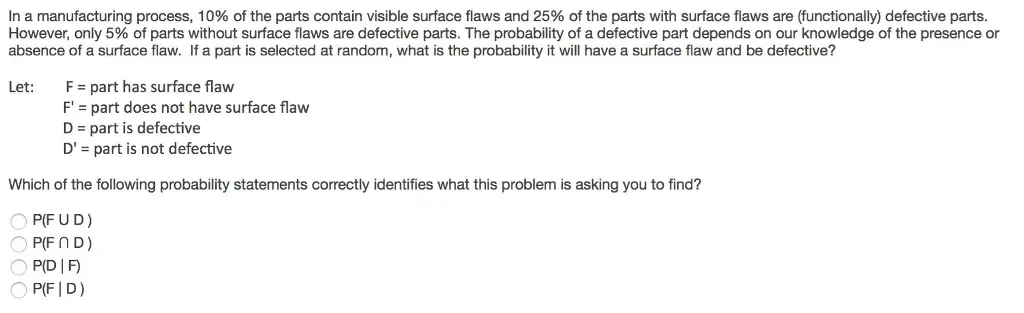
Transcribed Image Text:
In a manufacturing process, 10% of the parts contain visible surface flaws and 25% of the parts with surface flaws are (functionally) defective parts.
However, only 5% of parts without surface flaws are defective parts. The probability of a defective part depends on our knowledge of the presence or
absence of a surface flaw. If a part is selected at random, what is the probability it will have a surface flaw and be defective?
Let:
F = part has surface flaw
F' = part does not have surface flaw
D = part is defective
D' part is not defective
Which of the following probability statements correctly identifies what this problem is asking you to find?
P(FUD)
P(FND)
P(D|F)
P(F|D)
Customers are used to evaluate preliminary product designs. In the past, 95% of highly successful products received good reviews, 60% of moderately
successful products received good reviews, and 10% of poor products received good reviews. In addition, 40% of products have been highly successful,
35% have been moderately successful, and 25% have been poor products. (a) What is the probability that a product attains a good review? (b) If a new
design attains a good review, what is the probability that it will be a highly successful product? (c) If a product does not attain a good review, what is the
probability that it will be a highly successful product?
Let:
H = highly successful product
M = moderately successful product
P = poor product
G = received a good review (i.e., received bad review)
G' = did not receive a good review (i.e., received bad review)
Match the correct probability description to each given probability value.
0.95
0.60
0.10
0.40
0.25
Find:
A. P(H' | G')
B. P(H)
C. P(G|M)
D. P(GH)
E. P(G|H)
F. P(M)
G.P(H|G')
H. P(P)
I. P(G|P)
check_circle الجواب — حل مفصل خطوة بخطوة
hourglass_top
🔒
الحل الكامل متاح للمشتركين
اشترك في أرشيف الأسئلة لعرض هذا الحل وآلاف الحلول المفصلة خطوة بخطوة من معلمين معتمدين.