تم الحل ✓
categoryهندسة كيميائية
schoolبكالوريوس
event_available2026-07-13
السؤال
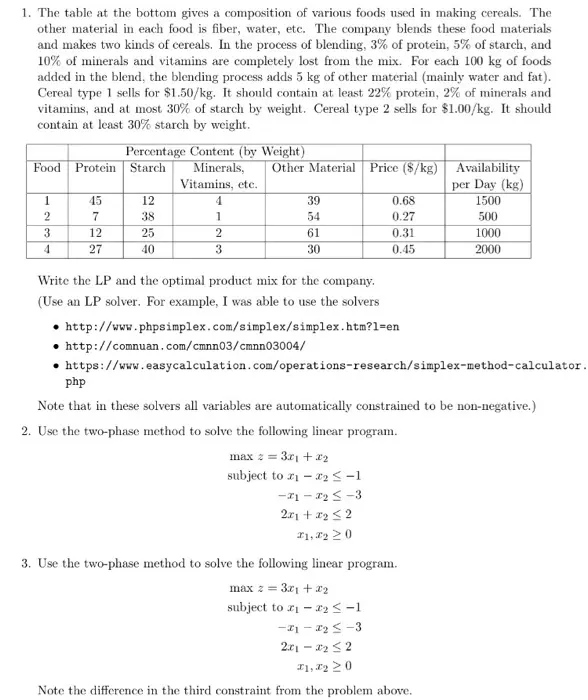
Transcribed Image Text:
1. The table at the bottom gives a composition of various foods used in making cereals. The
other material in each food is fiber, water, etc. The company blends these food materials
and makes two kinds of cereals. In the process of blending, 3% of protein, 5% of starch, and
10% of minerals and vitamins are completely lost from the mix. For each 100 kg of foods
added in the blend, the blending process adds 5 kg of other material (mainly water and fat).
Cereal type 1 sells for $1.50/kg. It should contain at least 22% protein, 2% of minerals and
vitamins, and at most 30% of starch by weight. Cereal type 2 sells for $1.00/kg. It should
contain at least 30% starch by weight.
Percentage Content (by Weight)
Other Material Price ($/kg) Availability
Food Protein Starch
Minerals,
Vitamins, etc.
per Day (kg)
1
2
3
4
6722
45
12
4
39
0.68
1500
38
1
54
0.27
500
12
25
2
61
0.31
1000
40
3
30
0.45
2000
Write the LP and the optimal product mix for the company.
(Use an LP solver. For example, I was able to use the solvers
http://www.phpsimplex.com/simplex/simplex.htm?l=en
http://comnuan.com/cmnn03/cmnn03004/
https://www.easycalculation.com/operations-research/simplex-method-calculator.
php
Note that in these solvers all variables are automatically constrained to be non-negative.)
2. Use the two-phase method to solve the following linear program.
max 3x1 + x2
subject to x1-22-1
-21-22-3
2x+2≤2
21, 20
3. Use the two-phase method to solve the following linear program.
max=3x1 + x2
subject to 1-2-1
-21-22-3
2x1-22
1,20
Note the difference in the third constraint from the problem above.
4. Use the two-phase method to solve the following linear program.
max z=
3x2+x3
subject to 1+ 2x2 + 3 ≤2
2x12 3-1
-
3x+2x+33
21, 22, 23 20
5. The Transportation Problem (known also as the Hitchcock problem) is as follows. There are
m sources of some commodity, each with a supply of a; units, i = 1,...,m and n terminals,
each of which has a demand of b; units, j = 1,..., n. The cost of sending a unit from source
i to terminal j is c, and a = b. We want to find a cheapest way to satisfy all
demands. State this problem as an LP. (The general answer can be expressed in a compact
form.)
check_circle الجواب — حل مفصل خطوة بخطوة
hourglass_top
🔒
الحل الكامل متاح للمشتركين
اشترك في أرشيف الأسئلة لعرض هذا الحل وآلاف الحلول المفصلة خطوة بخطوة من معلمين معتمدين.