تم الحل ✓
categoryهندسة طبية وبيومكترونيك
schoolبكالوريوس
event_available2026-07-13
السؤال
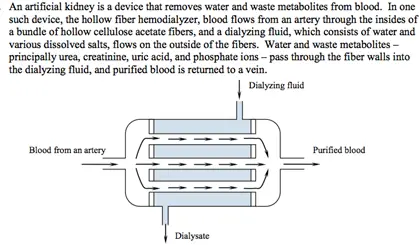
Transcribed Image Text:
An artificial kidney is a device that removes water and waste metabolites from blood. In one
such device, the hollow fiber hemodialyzer, blood flows from an artery through the insides of
a bundle of hollow cellulose acetate fibers, and a dialyzing fluid, which consists of water and
various dissolved salts, flows on the outside of the fibers. Water and waste metabolites -
principally urea, creatinine, uric acid, and phosphate ions - pass through the fiber walls into
the dialyzing fluid, and purified blood is returned to a vein.
Dialyzing fluid
Blood from an artery
Dialysate
Purified blood
At some time during a dialysis, the arterial and venous blood conditions are as follows:
Arterial (entering) Verous (exiting)
Flow rate
Urea concentration
Blood
200.0 mL/min
1.90 mg/mL
Blood
195.0 mL/min
1.75 mg/mL
(a) Calculate the rates at which urea and water are being removed from the blood.
(b) If the dialysis fluid enters at a rate of 1500. mL/min and exiting solution (dialysate)
leaves at approximately the same rate, calculate the concentration of urea in the dialysate.
(c) Suppose we want to reduce the patient's urea from an initial value of 2.7 mg/mL to a final
value of 1.1 mg/mL. If the blood volume is 5.0 liters and the average rate of urea
removal is that calculated in part (a), how long must the patient be dialyzed? (Neglect
the loss in total blood volume due to the removal of water in the dialyzer.)
check_circle الجواب — حل مفصل خطوة بخطوة
hourglass_top
🔒
الحل الكامل متاح للمشتركين
اشترك في أرشيف الأسئلة لعرض هذا الحل وآلاف الحلول المفصلة خطوة بخطوة من معلمين معتمدين.