تم الحل ✓
categoryهندسة كهربائية
schoolبكالوريوس
event_available2026-07-13
السؤال
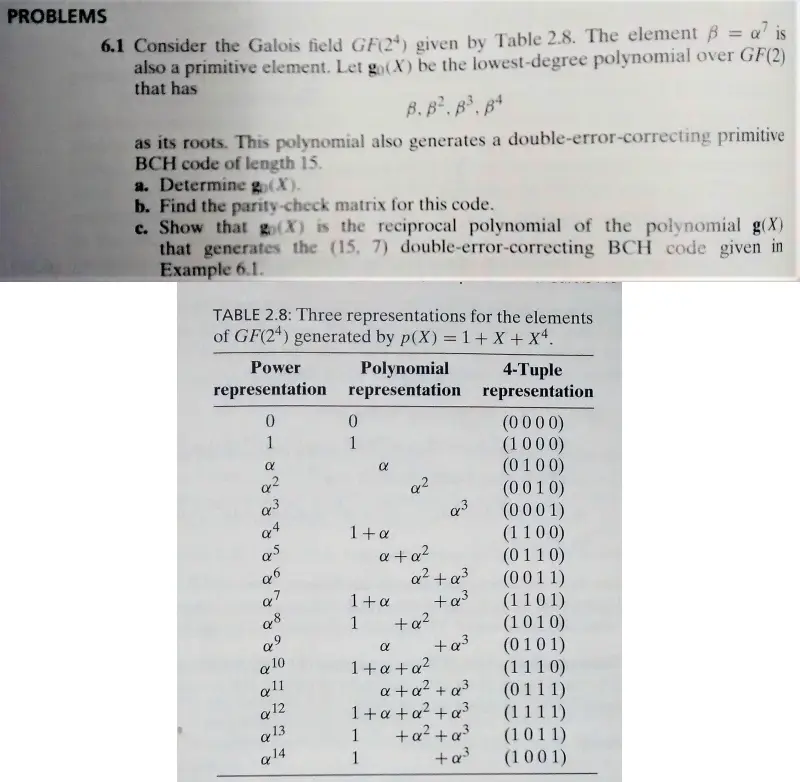
Transcribed Image Text:
PROBLEMS
6.1 Consider the Galois field GF(24) given by Table 2.8. The element 8 = a is
also a primitive element. Let go(X) be the lowest-degree polynomial over GF(2)
that has
B.B2.83.84
as its roots. This polynomial also generates a double-error-correcting primitive
BCH code of length 15.
a. Determine g(X).
b. Find the parity-check matrix for this code.
c. Show that go(X) is the reciprocal polynomial of the polynomial g(X)
that generates the (15, 7) double-error-correcting BCH code given in
Example 6.1.
TABLE 2.8: Three representations for the elements
of GF(24) generated by p(X) = 1+X+X4.
Power
representation
Polynomial
representation
α
1
0
0
1
4-Tuple
representation
(0000)
α
(1000)
a²
(0100)
Q3
(0010)
Q4
α3
1 + α
(0001)
аб
a+a²
(1100)
α7
a² + a³
(0110)
1+α
(0011)
Q8
1
Q9
+α²
(1101)
(1010)
α
α10
1+a+a²
(0101)
a11
(1110)
α12
α13
1+a+a²+a³
(0111)
1
(1111)
14
1
(1011)
(1001)
PROBLEMS
6.1 Consider the Galois field GF(24) given by Table 2.8. The element ẞ = a is
also a primitive element. Let go(X) be the lowest-degree polynomial over GF(2)
that has
8.82.83.84
as its roots. This polynomial also generates a double-error-correcting primitive
BCH code of length 15.
a. Determine go(X).
b. Find the parity-check matrix for this code.
c. Show that g(X) is the reciprocal polynomial of the polynomial g(X)
that generates the (15, 7) double-error-correcting BCH code given in
Example 6.1.
check_circle الجواب — حل مفصل خطوة بخطوة
hourglass_top
🔒
الحل الكامل متاح للمشتركين
اشترك في أرشيف الأسئلة لعرض هذا الحل وآلاف الحلول المفصلة خطوة بخطوة من معلمين معتمدين.