تم الحل ✓
categoryإدارة أعمال
schoolبكالوريوس
event_available2026-07-13
السؤال
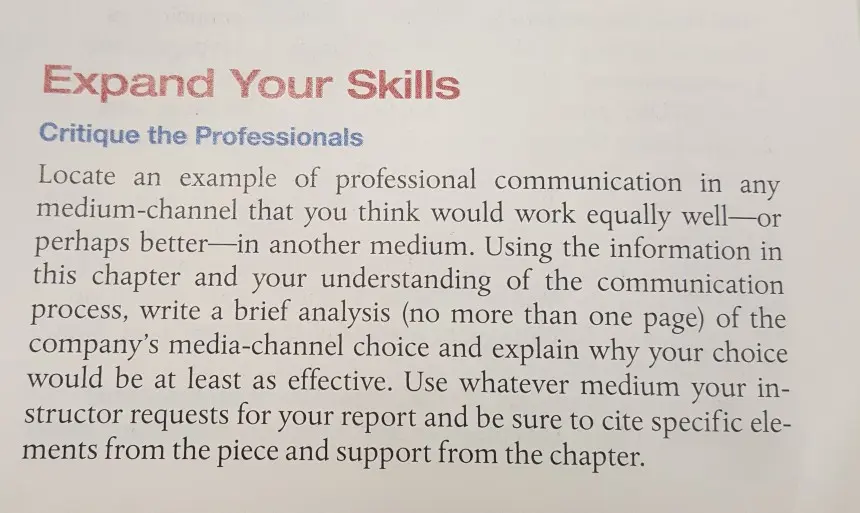
Transcribed Image Text:
Expand Your Skills
Critique the Professionals
Locate an example of professional communication in any
medium-channel that you think would work equally well-or
perhaps better-in another medium. Using the information in
this chapter and your understanding of the communication
process, write a brief analysis (no more than one page) of the
company's media-channel choice and explain why your choice
would be at least as effective. Use whatever medium your in-
structor requests for your report and be sure to cite specific ele-
ments from the piece and support from the chapter.
ng the Three-Step Writing Process
h
Selecting the Best Combination
of Media and Channels
With the necessary information in hand, your next decision involves the best combina
tion of media and channels to reach your target audience. As you recall from Chapter 1,
the medium is the form a message takes and the channel is the system used to deliver the
message. The distinction between the two isn't always crystal clear, and some people use
the terms in different ways, but these definitions are a useful way to think about the pos-
sibilities for business communication.
Most media can be distributed through more than one channel, so whenever you have
a choice, think through your options to select the optimum combination. For example, a
brief written message could be distributed as a printed letter or memo, or it could be dis
tributed through a variety of digital channels, from email to blogging to social networking
THE MOST COMMON MEDIA AND CHANNEL OPTIONS
The simplest way to categorize media choices is to divide them into oral (spoken), writ-
ten, and visual. Each of these media can be delivered through digital and nondigital channels
which creates six basic combinations, discussed in the following sections. Table 4.1 sum-
marizes the general advantages and disadvantages of the six medium/channel combina-
tions. Specific options within these categories have their own strengths and weaknesses
to consider as well. (For simplicity's sake, subsequent chapters occasionally use "digital
media" to indicate any of the three media types delivered through digital channels.)
Oral Medium, In-Person Channel
The oral medium, in-person combo involves talking with people who are in the same
location, whether it's a one-on-one conversation over lunch or a more formal speech or
presentation. Being in the same physical space is a key distinction because it enables the
nuances of nonverbal communication more than any other media-channel combo. As
Chapter 2 points out, these nonverbal signals can carry as much weight in the conversa-
tion as the words being spoken.
By giving people the ability to see, hear, and react to each other, in-person commu-
nication is useful for encouraging people to ask questions, make comments, and work
together to reach a consensus or decision. Face-to-face interaction is particularly helpful
in complex, emotionally charged situations in which establishing or fostering a business
relationship is important Managers who engage in frequent "walk-arounds," chatting
with employees face-to-face, can get input, answer questions, and interpret important
business events and trends."
Oral Medium, Digital Channel
Oral media via digital channels include any transmission of voice via electronic means,
both live and recorded, including telephone calls, podcasts, and voicemail messages.
Live phone conversations offer the give-and-take of in-person conversations and can
be the best alternative to talking in person. However, without a video component, they
can't provide the nuances of nonverbal communication. Podcasts can be a good way to
share lectures, commentary, and other spoken content. You can read about podcasting in
Chapter 7,
Written Medium, Print Channel
Written, printed documents are the classic format of business communication. Memos
are brief printed documents traditionally used for the routine, day-to-day exchange of
information within an organization. Letters are brief written messages sent to customers
and other recipients outside the organization. Reports and proposals are usually longer
than memos and letters, although both can be created in memo or letter format. These
documents come in a variety of lengths, ranging from a few pages to several hundred, and
are usually fairly formal in tone.
CHAPTER 4 Planning Business Messages 107
TABLE 4.1 Medium/Channel Combinations: Advantages and Disadvantages
Medium/ Channel
Oral, in-person
Oral, digital
Written, printed
Written, digital
Visual, printed
Visual, digital
Advantages
•Provide opportunity for immediate feedback
Easily resolve misunderstandings and negotiate meanings
•Involve rich nonverbal cues (both physical gesture and
vocal inflection)
• Allow you to express the emotion behind your message
Can provide opportunity for immediate feedback (live
phone or online conversations)
Not restricted to participants in the same location
Allow time-shifted consumption (e.g.. podcasts)
Allow writers to plan and control their messages
Can reach geographically dispersed audiences
Offer a permanent, verifiable record
Minimize the distortion that can accompany oral
messages
Can be used to avoid immediate interactions
• Deemphasize any inappropriate emotional components
Give recipients time to process messages before
responding (compared to oral communication)
Generally, all the advantages of written printed documents
plus:
. Fast delivery
•
• Can reach geographically dispersed audiences
Flexibility of multiple formats and channels, from
microblogs to wikis
Flexibility to structure messages in creative ways, such
as writing a headline on Twitter and linking to the full
message on a blog
Ability to link to related and more in-depth information.
• Can increase accessibility and openness in an
organization through broader sharing
• Enable audience interaction through social media features
Ease of integrating with other media types, such as
embedded videos or photos
Can convey complex ideas and relationships quickly
Often less intimidating than long blocks of text
Can reduce the burden on the audience to figure out how
the pieces of a message or concept fit
Can be easy to create in spreadsheets and other software
(simple charts and graphs), then integrate with reports
Generally, all the advantages of visual printed documents
and all the advantages of written digital formats plus:
Can personalize and enhance the experience for audience
members
Offer the persuasive power of multimedia formats,
particularly video
Disadvantages
Restrict participation to those physically present
Unless recorded, provide no permanent,
verifiable record of the communication
Reduces communicator's control over the
message
Lack nonverbal cues other than voice inflections
• Can be tedious to listen to if not audience
focused (recorded messages)
•Offer limited opportunities for timely feedback
• Lack the rich nonverbal cues provided by oral
media
Often take more time and more resources to
create and distribute
•
•
Can require special skills in preparation and
production if document is elaborate
Can be limited in terms of reach and capability
(e.g., on Twitter you can reach only those people
who follow you or search for you)
Require Internet or mobile phone connectivity
Vulnerable to security and privacy problems
Are easy to overuse (sending too many
messages to too many recipients)
Create privacy risks and concerns (exposing
confidential data; employer monitoring:
accidental forwarding)
Entail security risks (viruses, spyware; network
breaches)
Create productivity concerns (frequent
interruptions; nonbusiness usage)
Can require artistic skills to design
Require some technical skills to create
Can require more time to create than equivalent
amount of text
• Can be expensive to print
Potential time, cost, and skills needed to create
Can require large amounts of bandwidth
Written Medium, Digital Channel
Most of your business communication efforts will involve written digital messages, with
everything from 140-character tweets to website content to book-length reports distributed
as portable document format (PDF) files (see Figure 4.4). Business uses of written, digital
messages keeps evolving as companies look for ways to communicate more effectively. For
example, email has been a primary business medium for the past decade or two, but it is being
replaced in many cases by a variety of other digital formats. Chapter 7 takes a closer look at
various written-digital combinations, from email to instant messaging (IM) to social networks.
Visual Medium, Print Channel
Photographs and diagrams can be effective communication tools for conveying emotional
content, spatial relationships, technical processes, and other content that can be difficult
to describe using words alone. You may occasionally create visual, printed messages as
stand-alone items, but most will be used as supporting material in printed documents.
Visual Medium, Digital Channel
Business messages can really come alive when conveyed by visual media in digital chan-
nels. Infographics, interactive diagrams, animation, and digital video have the potential to
check_circle الجواب — حل مفصل خطوة بخطوة
hourglass_top
🔒
الحل الكامل متاح للمشتركين
اشترك في أرشيف الأسئلة لعرض هذا الحل وآلاف الحلول المفصلة خطوة بخطوة من معلمين معتمدين.