تم الحل ✓
categoryهندسة ميكانيكية
schoolبكالوريوس
event_available2026-07-13
السؤال
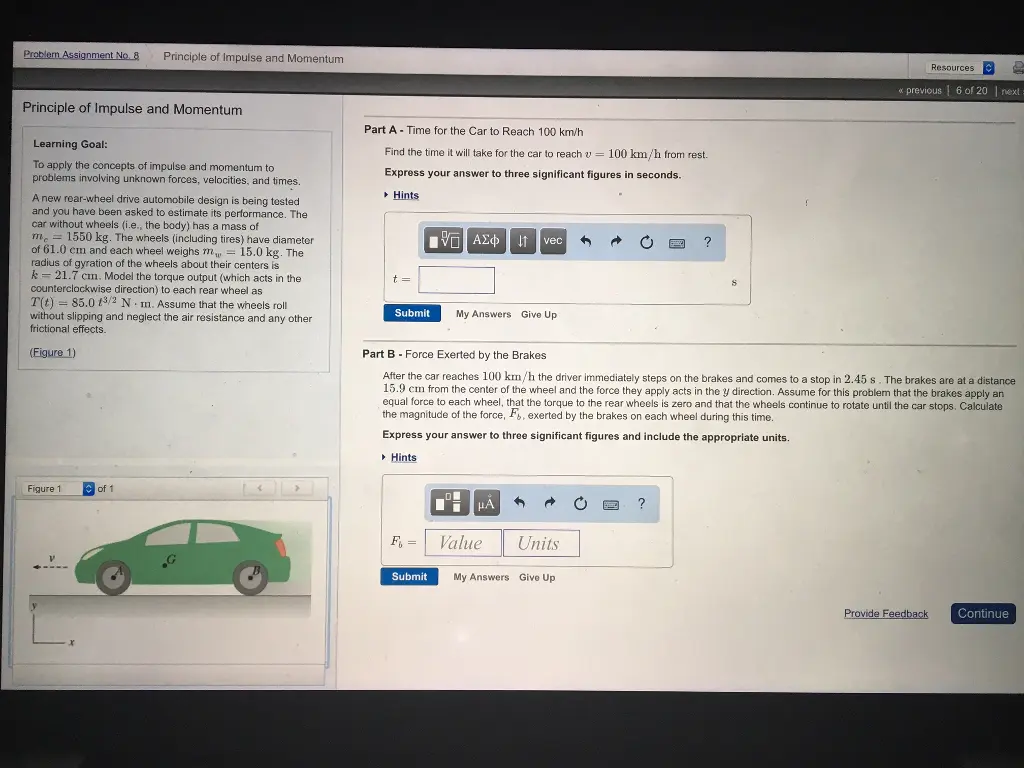
Transcribed Image Text:
Problem Assignment No. 8 Principle of Impulse and Momentum
Resources
« previous 6 of 20 | next =
Principle of Impulse and Momentum
Learning Goal:
To apply the concepts of impulse and momentum to
problems involving unknown forces, velocities, and times.
A new rear-wheel drive automobile design is being tested.
and you have been asked to estimate its performance. The
car without wheels (i.e., the body) has a mass of
me
1550 kg. The wheels (including tires) have diameter
of 61.0 cm and each wheel weighs m, 15.0 kg. The
radius of gyration of the wheels about their centers is
k 21.7 cm. Model the torque output (which acts in the
counterclockwise direction) to each rear wheel as
T(t) 85.0 13/2 N m. Assume that the wheels roll
without slipping and neglect the air resistance and any other
frictional effects.
(Figure 1)
Part A Time for the Car to Reach 100 km/h
Find the time it will take for the car to reach v = 100 km/h from rest.
Express your answer to three significant figures in seconds.
▸ Hints
ΜΕ ΑΣΦ 11 vec
Submit
My Answers Give Up
Part B - Force Exerted by the Brakes
8.
After the car reaches 100 km/h the driver immediately steps on the brakes and comes to a stop in 2.45 s. The brakes are at a distance
15.9 cm from the center of the wheel and the force they apply acts in the y direction. Assume for this problem that the brakes apply an
equal force to each wheel, that the torque to the rear wheels is zero and that the wheels continue to rotate until the car stops. Calculate
the magnitude of the force, F, exerted by the brakes on each wheel during this time.
Express your answer to three significant figures and include the appropriate units.
Figure 1
of 1
▸ Hints
F₁
Value
Units
Submit
My Answers Give Up
Provide Feedback
Continue
check_circle الجواب — حل مفصل خطوة بخطوة
hourglass_top
🔒
الحل الكامل متاح للمشتركين
اشترك في أرشيف الأسئلة لعرض هذا الحل وآلاف الحلول المفصلة خطوة بخطوة من معلمين معتمدين.