تم الحل ✓
categoryفيزياء
schoolبكالوريوس
event_available2026-07-13
السؤال
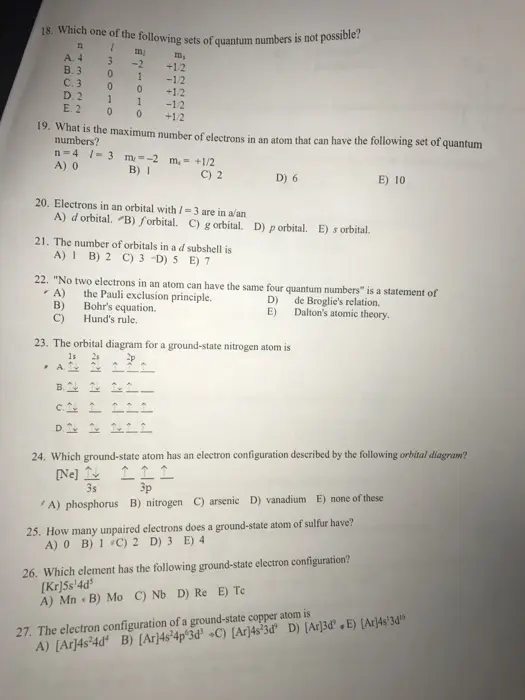
Transcribed Image Text:
18. Which one of the following sets of quantum numbers is not possible?
A.4 3 -2
+12
B.3
0
1
-1/2
C.3
0
0
+1/2
D. 2
1
1
-1/2
E.2
0
0
+1/2
19. What is the maximum number of electrons in an atom that can have the following set of quantum
numbers?
n-4-3 m =-2 m, +1/2
A) 0
B) 1
C) 2
D) 6
E) 10
20. Electrons in an orbital with /-3 are in a/an
A) d orbital. "B) forbital. C) g orbital. D) p orbital. E) s orbital.
21. The number of orbitals in a d subshell is
A) 1 B) 2 C) 3 -D) 5 E) 7
22. "No two electrons in an atom can have the same four quantum numbers" is a statement of
D)
de Broglie's relation.
E)
Dalton's atomic theory.
- A)
the Pauli exclusion principle.
B)
C)
Bohr's equation.
Hund's rule.
23. The orbital diagram for a ground-state nitrogen atom is
2s
A
B._
CRP PPP
DL
24. Which ground-state atom has an electron configuration described by the following orbital diagram?
[Ne] 1
3s
111
3p
A) phosphorus B) nitrogen C) arsenic D) vanadium E) none of these
25. How many unpaired electrons does a ground-state atom of sulfur have?
A) 0 B) 1 C) 2 D) 3 E) 4
26. Which element has the following ground-state electron configuration?
[Kr]5s'4d³
A) Mn B) Mo C) Nb D) Re E) Te
27. The electron configuration of a ground-state copper atom is
A) [Ar]4s 4d B) [Ar]4s4p 3d +C) [Ar]4s 3d D) [Ar]3d' E) [Ar]4s'3d
check_circle الجواب — حل مفصل خطوة بخطوة
hourglass_top
🔒
الحل الكامل متاح للمشتركين
اشترك في أرشيف الأسئلة لعرض هذا الحل وآلاف الحلول المفصلة خطوة بخطوة من معلمين معتمدين.