تم الحل ✓
categoryهندسة كهربائية
schoolبكالوريوس
event_available2026-07-13
السؤال
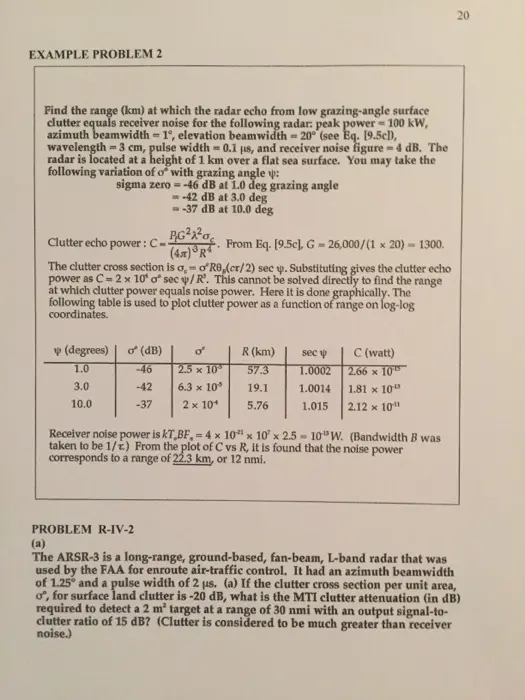
Transcribed Image Text:
EXAMPLE PROBLEM 2
20
20
Find the range (km) at which the radar echo from low grazing-angle surface
clutter equals receiver noise for the following radar: peak power - 100 kW,
azimuth beamwidth-1°, elevation beamwidth -20° (see Eq. [9.5cl),
wavelength=3 cm, pulse width 0.1 us, and receiver noise figure - 4 dB. The
radar is located at a height of 1 km over a flat sea surface. You may take the
following variation of of with grazing angle :
sigma zero -46 dB at 1.0 deg grazing angle
Clutter echo power: C--
=-42 dB at 3.0 deg
-37 dB at 10.0 deg
BG22
(4x) R
From Eq. [9.5c], G-26,000/(1 x 20) = 1300.
The clutter cross section is o, o'RB,(cr/2) sec pp. Substituting gives the clutter echo
power as C-2 x 10' o° sec w/R. This cannot be solved directly to find the range
at which clutter power equals noise power. Here it is done graphically. The
following table is used to plot clutter power as a function of range on log-log
coordinates.
(degrees)
o' (dB)
0'
R (km)
sec p
C (watt)
1.0
-46
2.5 x 10
57.3
1.0002
2.66 x 10
3.0
-42
6.3 x 10°
19.1
1.0014
1.81 x 10"
10.0
-37
2 x 10
5.76
1.015
2.12 x 10"1
Receiver noise power is KT,BF, 4 x 10" x 10' x 2.5 10" W. (Bandwidth B was
taken to be 1/) From the plot of C vs R, it is found that the noise power
corresponds to a range of 22.3 km, or 12 nmi.
PROBLEM R-IV-2
(a)
The ARSR-3 is a long-range, ground-based, fan-beam, L-band radar that was
used by the FAA for enroute air-traffic control. It had an azimuth beamwidth
of 1.25° and a pulse width of 2 us. (a) If the clutter cross section per unit area,
o', for surface land clutter is -20 dB, what is the MTI clutter attenuation (in dB)
required to detect a 2 m² target at a range of 30 nmi with an output signal-to-
clutter ratio of 15 dB? (Clutter is considered to be much greater than receiver
noise.)
21
(Solution hint: Find clutter area based clutter cross section. Find the ratio of clutter cross
section to given target cross section. Hence find clutter attenuation. Answer: 47.6 dB)
mm/hour?
(b) What will be the radar cross section of rain clutter (in mseen by the ARSR-
3 radar at a range of 30 nmi when the rainfall rate is 4- You may assume
a flat earth and that the rain uniformly fills the radar resolution cell from the
ground up to a height h of 3 km. Take the radar frequency to be 1.3 GHz. (The
elevation coverage should not be needed here.)
(Solution hint: Find volume clutter cross section and equation 7.32. Answer: 0.2 m²)
ra
und, watts. This
measure rainfall. The received power varies as 1/R²
al radar equation for conventional "point" targets.
ter cross section of rain per unit volume, n, as a funct
s shown plotted in Fig. 7.18. The dashed lines apply
A, and were obtained by summing the values of oσ g
me and using Eqs. (7.29) and (7.30) to give
n = Σσ = 7f41.6 × 10-12 m²/m³
x
omputed by Haddock. 107
ar frequency in GHz and r the rainfall rate in mm/h
Rayleigh scattering is seer
most of the frequency range of interest to radar.
check_circle الجواب — حل مفصل خطوة بخطوة
hourglass_top
🔒
الحل الكامل متاح للمشتركين
اشترك في أرشيف الأسئلة لعرض هذا الحل وآلاف الحلول المفصلة خطوة بخطوة من معلمين معتمدين.