تم الحل ✓
categoryبرمجة وتطوير البرمجيات
schoolبكالوريوس
event_available2026-07-13
السؤال
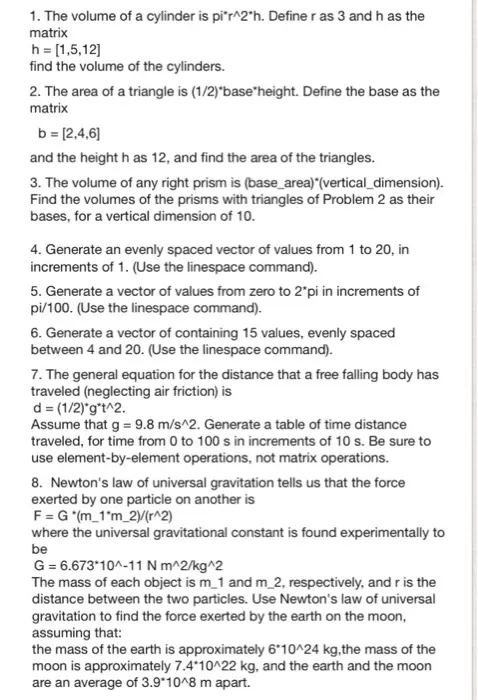
Transcribed Image Text:
1. The volume of a cylinder is pi*r^2*h. Define r as 3 and h as the
matrix
h = [1,5,12]
find the volume of the cylinders.
2. The area of a triangle is (1/2)"base"height. Define the base as the
matrix
b = [2,4,6]
and the height h as 12, and find the area of the triangles.
3. The volume of any right prism is (base_area)*(vertical_dimension).
Find the volumes of the prisms with triangles of Problem 2 as their
bases, for a vertical dimension of 10.
4. Generate an evenly spaced vector of values from 1 to 20, in
increments of 1. (Use the linespace command).
5. Generate a vector of values from zero to 2*pi in increments of
pi/100. (Use the linespace command).
6. Generate a vector of containing 15 values, evenly spaced
between 4 and 20. (Use the linespace command).
7. The general equation for the distance that a free falling body has
traveled (neglecting air friction) is
d = (1/2)*g*t^2.
Assume that g = 9.8 m/s^2. Generate a table of time distance
traveled, for time from 0 to 100 s in increments of 10 s. Be sure to
use element-by-element operations, not matrix operations.
8. Newton's law of universal gravitation tells us that the force
exerted by one particle on another is
F G (m_1*m_2)/(r^2)
where the universal gravitational constant is found experimentally to
be
G = 6.673*10^-11 N m^2/kg^2
The mass of each object is m_1 and m 2, respectively, and r is the
distance between the two particles. Use Newton's law of universal
gravitation to find the force exerted by the earth on the moon,
assuming that:
the mass of the earth is approximately 6*10^24 kg,the mass of the
moon is approximately 7.4*10^22 kg, and the earth and the moon
are an average of 3.9*10^8 m apart.
check_circle الجواب — حل مفصل خطوة بخطوة
hourglass_top
🔒
الحل الكامل متاح للمشتركين
اشترك في أرشيف الأسئلة لعرض هذا الحل وآلاف الحلول المفصلة خطوة بخطوة من معلمين معتمدين.