تم الحل ✓
categoryإحصاء
schoolبكالوريوس
event_available2026-07-13
السؤال
Transcribed Image Text:
-
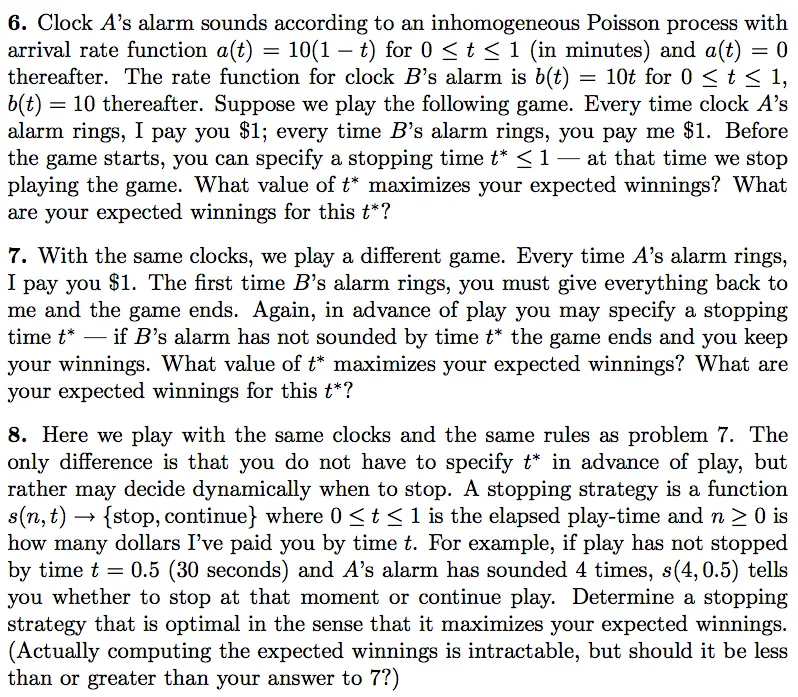
6. Clock A's alarm sounds according to an inhomogeneous Poisson process with
arrival rate function a(t) = 10(1 − t) for 0 ≤ t≤ 1 (in minutes) and a(t) = 0
thereafter. The rate function for clock B's alarm is b(t) = 10t for 0 ≤ t≤ 1,
b(t) =
= 10 thereafter. Suppose we play the following game. Every time clock A's
alarm rings, I pay you $1; every time B's alarm rings, you pay me $1. Before
the game starts, you can specify a stopping time t* <1 at that time we stop
playing the game. What value of t* maximizes your expected winnings? What
are your expected winnings for this t*?
-
7. With the same clocks, we play a different game. Every time A's alarm rings,
I pay you $1. The first time B's alarm rings, you must give everything back to
me and the game ends. Again, in advance of play you may specify a stopping
time t* if B's alarm has not sounded by time t* the game ends and you keep
your winnings. What value of t* maximizes your expected winnings? What are
your expected winnings for this t*?
8. Here we play with the same clocks and the same rules as problem 7. The
only difference is that you do not have to specify t* in advance of play, but
rather may decide dynamically when to stop. A stopping strategy is a function
s(n,t). →> {stop, continue} where 0 <t≤1 is the elapsed play-time and n ≥ 0 is
how many dollars I've paid you by time t. For example, if play has not stopped
by time t = 0.5 (30 seconds) and A's alarm has sounded 4 times, s(4,0.5) tells
you whether to stop at that moment or continue play. Determine a stopping
strategy that is optimal in the sense that it maximizes your expected winnings.
(Actually computing the expected winnings is intractable, but should it be less
than or greater than your answer to 7?)
check_circle الجواب — حل مفصل خطوة بخطوة
hourglass_top
🔒
الحل الكامل متاح للمشتركين
اشترك في أرشيف الأسئلة لعرض هذا الحل وآلاف الحلول المفصلة خطوة بخطوة من معلمين معتمدين.