تم الحل ✓
categoryرياضيات
schoolبكالوريوس
event_available2026-07-13
السؤال
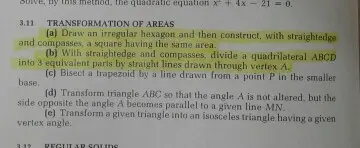
Transcribed Image Text:
he quadratic equation
+4x 21 = 0.
3.11 TRANSFORMATION OF AREAS
(a) Draw an irregular hexagon and then construct, with straightedge
and compasses, a square having the same area.
(b) With straightedge and compasses, divide a quadrilateral ABCD
into 3 equivalent parts by straight lines drawn through vertex A.
(c) Bisect a trapezoid by a line drawn from a point P in the smaller
base.
(d) Transform triangle ABC so that the angle A is not altered, but the
side opposite the angle A becomes parallel to a given line MN.
(e) Transform a given triangle into an isosceles triangle having a given
vertex angle.
312
REGULA
3.11
-
ly
22xr+al+rsly-21-4y] = 0.
a pair of lines on the intersections of the circle with the lines AR and
AS. It follows that the second factor set equal to 0 represents the line.
RS. Setting y 0, we find OLrs/le + s) h/g setting y-2, we
find AT 4/(r+s)-4/g
(b) First trisect the diagonal BD by points E and F. Then the broken lines
AEC and AFC divide the figure into 3 equivalent parts. Transform these
parts so as to fulfull the conditions by drawing parallels to AC through
E and F.
(d) Through B draw BD parallel to MN to cut AC in D. Then, if the required
triangle is AB'C', AC' is a mean proportional between AC and AD.
(e) Let ABC be the given triangle. Draw AB' making the given vertex angle
arallel to AC through B in B. Now
lat it cut
check_circle الجواب — حل مفصل خطوة بخطوة
hourglass_top
🔒
الحل الكامل متاح للمشتركين
اشترك في أرشيف الأسئلة لعرض هذا الحل وآلاف الحلول المفصلة خطوة بخطوة من معلمين معتمدين.