تم الحل ✓
categoryذكاء اصطناعي وتعلم آلة
schoolبكالوريوس
event_available2026-07-13
السؤال
Transcribed Image Text:
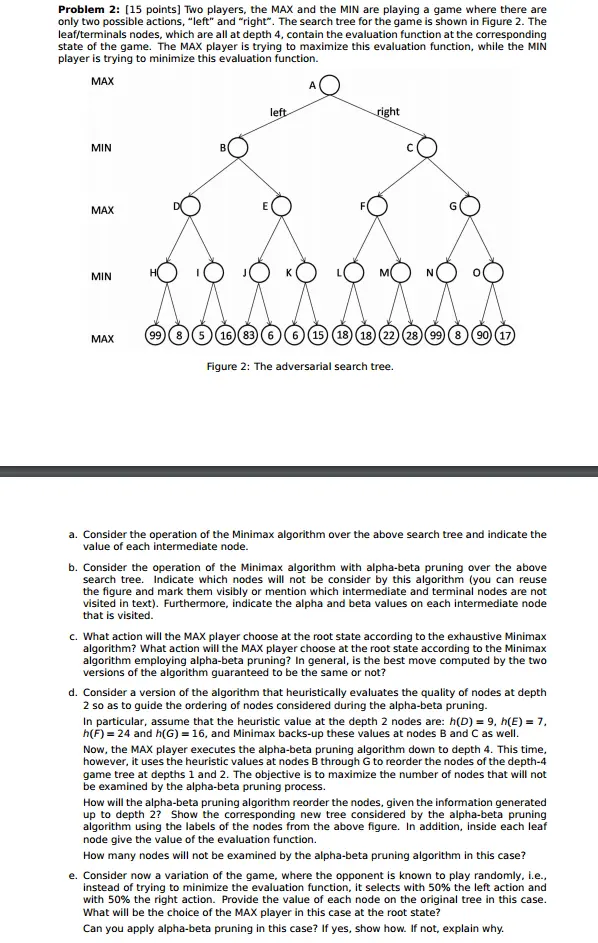
Problem 2: [15 points] Two players, the MAX and the MIN are playing a game where there are
only two possible actions, "left" and "right". The search tree for the game is shown in Figure 2. The
leaf/terminals nodes, which are all at depth 4, contain the evaluation function at the corresponding
state of the game. The MAX player is trying to maximize this evaluation function, while the MIN
player is trying to minimize this evaluation function.
MAX
MIN
MAX
MIN
left.
right
(99)
MAX
8 5 16 83 6 6 15 18 18 22 28 99
8
Figure 2: The adversarial search tree.
a. Consider the operation of the Minimax algorithm over the above search tree and indicate the
value of each intermediate node.
b. Consider the operation of the Minimax algorithm with alpha-beta pruning over the above
search tree. Indicate which nodes will not be consider by this algorithm (you can reuse
the figure and mark them visibly or mention which intermediate and terminal nodes are not
visited in text). Furthermore, indicate the alpha and beta values on each intermediate node
that is visited.
c. What action will the MAX player choose at the root state according to the exhaustive Minimax
algorithm? What action will the MAX player choose at the root state according to the Minimax
algorithm employing alpha-beta pruning? In general, is the best move computed by the two
versions of the algorithm guaranteed to be the same or not?
d. Consider a version of the algorithm that heuristically evaluates the quality of nodes at depth
2 so as to guide the ordering of nodes considered during the alpha-beta pruning.
In particular, assume that the heuristic value at the depth 2 nodes are: h(D) = 9, h(E) = 7,
h(F)=24 and h(G)=16, and Minimax backs-up these values at nodes B and C as well.
Now, the MAX player executes the alpha-beta pruning algorithm down to depth 4. This time,
however, it uses the heuristic values at nodes B through G to reorder the nodes of the depth-4
game tree at depths 1 and 2. The objective is to maximize the number of nodes that will not
be examined by the alpha-beta pruning process.
How will the alpha-beta pruning algorithm reorder the nodes, given the information generated
up to depth 2? Show the corresponding new tree considered by the alpha-beta pruning
algorithm using the labels of the nodes from the above figure. In addition, inside each leaf
node give the value of the evaluation function.
How many nodes will not be examined by the alpha-beta pruning algorithm in this case?
e. Consider now a variation of the game, where the opponent is known to play randomly, i.e.,
instead of trying to minimize the evaluation function, it selects with 50% the left action and
with 50% the right action. Provide the value of each node on the original tree in this case.
What will be the choice of the MAX player in this case at the root state?
Can you apply alpha-beta pruning in this case? If yes, show how. If not, explain why.
check_circle الجواب — حل مفصل خطوة بخطوة
hourglass_top
🔒
الحل الكامل متاح للمشتركين
اشترك في أرشيف الأسئلة لعرض هذا الحل وآلاف الحلول المفصلة خطوة بخطوة من معلمين معتمدين.