تم الحل ✓
categoryالرياضيات
schoolبكالوريوس
event_available2026-07-16
السؤال
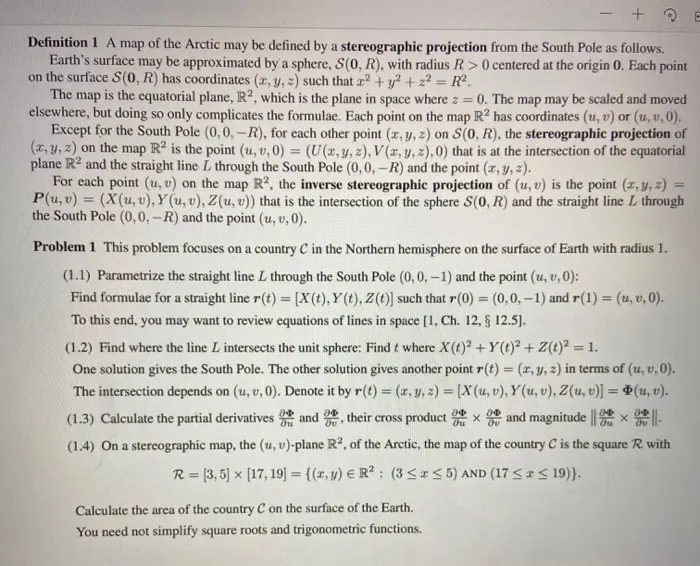
Transcribed Image Text:
+ Q
Definition 1 A map of the Arctic may be defined by a stereographic projection from the South Pole as follows.
Earth's surface may be approximated by a sphere, S(0, R), with radius R> 0 centered at the origin 0. Each point
on the surface S(0, R) has coordinates (x, y, z) such that r² + y²+22=R2.
The map is the equatorial plane, R2, which is the plane in space where z = 0. The map may be scaled and moved
elsewhere, but doing so only complicates the formulae. Each point on the map R2 has coordinates (u, v) or (u, v, 0).
Except for the South Pole (0, 0, -R), for each other point (x, y, z) on S(0, R), the stereographic projection of
(x, y, z) on the map R2 is the point (u, v, 0) = (U(x, y, z), V(x, y, z), 0) that is at the intersection of the equatorial
plane R2 and the straight line L through the South Pole (0, 0, -R) and the point (x, y, z).
=
For each point (u, v) on the map R2, the inverse stereographic projection of (u, v) is the point (x, y, z)
P(u,v) = (X(u, v), Y(u, v), Z(u, v)) that is the intersection of the sphere S(0, R) and the straight line L through
the South Pole (0,0,-R) and the point (u, v, 0).
Problem 1 This problem focuses on a country C in the Northern hemisphere on the surface of Earth with radius 1.
(1.1) Parametrize the straight line L through the South Pole (0, 0, -1) and the point (u, v, 0):
Find formulae for a straight line r(t) = [X(t), Y(t), Z(t)] such that r(0) = (0,0,-1) and r(1) = (u, v, 0).
To this end, you may want to review equations of lines in space [1, Ch. 12, § 12.5].
(1.2) Find where the line L intersects the unit sphere: Find & where X(t)2 + Y(t)2 + Z(t)² = 1.
(u, v).
One solution gives the South Pole. The other solution gives another point r(t) = (x, y, z) in terms of (u, v, 0).
The intersection depends on (u, v, 0). Denote it by r(t) = (x, y, z) = [X(u, v), Y(u, v), Z(u, v)] =
(1.3) Calculate the partial derivatives and their cross product
De
and magnitude |× ||-
(1.4) On a stereographic map, the (u, v)-plane R2, of the Arctic, the map of the country C is the square R with
R = [3,5] x [17, 19] = {(x,y) = R² (3≤x≤5) AND (17≤ x ≤19)}.
Calculate the area of the country C on the surface of the Earth.
You need not simplify square roots and trigonometric functions.
check_circle الجواب — حل مفصل خطوة بخطوة
hourglass_top
🔒
الحل الكامل متاح للمشتركين
اشترك في أرشيف الأسئلة لعرض هذا الحل وآلاف الحلول المفصلة خطوة بخطوة من معلمين معتمدين.