تم الحل ✓
categoryالكيمياء
schoolبكالوريوس
event_available2026-07-16
السؤال
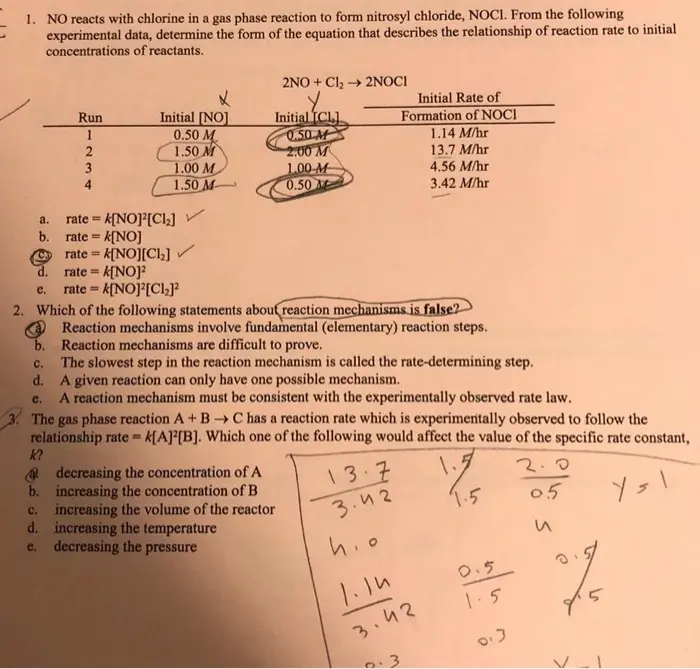
Transcribed Image Text:
1. NO reacts with chlorine in a gas phase reaction to form nitrosyl chloride, NOCI. From the following
experimental data, determine the form of the equation that describes the relationship of reaction rate to initial
concentrations of reactants.
2NO+Cl₂2NOCI
Initial Rate of
Run
Initial [NO]
Initial [CI]
Formation of NOCI
1
0.50 M
0.50 M
1.14 M/hr
2
1.50 M
2.00 M
13.7 M/hr
3
1.00 M
1.00-M
4.56 M/hr
1.50 M
0.50
3.42 M/hr
a.
rate=
k[NO]²[Cl₂]
b.
rate = k[NO]
rate=
= k[NO][Cl₂]
d. rate = k[NO]²
e. rate = k[NO][Cl₂]²
2. Which of the following statements about reaction mechanisms is false?
Reaction mechanisms involve fundamental (elementary) reaction steps.
b. Reaction mechanisms are difficult to prove.
c.
The slowest step in the reaction mechanism is called the rate-determining step.
d. A given reaction can only have one possible mechanism.
e. A reaction mechanism must be consistent with the experimentally observed rate law.
The gas phase reaction A + B C has a reaction rate which is experimentally observed to follow the
relationship rate = k[A][B]. Which one of the following would affect the value of the specific rate constant,
k?
e. decreasing the pressure
d. increasing the temperature
b. increasing the concentration of B
c. increasing the volume of the reactor
decreasing the concentration of A
13.7
3.42
2.0
1.5
05
h.o
и
1.14
0.5
3.42
1.5
2.3
0.3
>
4. Which one of the following statements is false?
a. A catalyst alters the rate of a reaction and is neither a product nor a reactant in the
overall equation.
b. According to collision theory a three-body collision is less likely than a two-body
C.
e.
collision.
In order for a reaction to occur, reactant molecules must collide with each other.
In reactions that are second order in one reactant and first order in another, the slow step
generally involves a three-body collision of these reactants.
The transition state is a short-lived, high energy state, intermediate between reactants and
products.
5. Consider the gas phase system below at a high temperature. The form of the expression for the equilibrium
constant, K
CaO(s)+ CH(g) + 2H2O(g) CaCO3(s) + 4H2(g)
is Ke=
[CaCO,][H₂]
[CaO][CH,][H,O]
b.
cannot be determined without rate data
C.
is K₁ =
d. is Ke=
e. is Ke=
[CaCO, ][H₂]
[CaO][CH][H,O]
[H₂]*
[CH][H,O]
[CaO][CH,][H,O]
[CaCO,] [H₂]*
[Ca co₂] [Hz]
(cao (chu3 CH2072
6. For the following reaction: CH,CH₂OH+[0]→ CH,CH=0+ H2O, if the initial concentration of alcohol
(reactant) is 0.015 mol/L and the rate constant = 6.4 x 10⁻² M' min', what is the concentration of alcohol
after 12.5 hours?
Ink-kt
(a
0.0087 mol/L
b.
0.00015 mol/L
C.
C(g)+2D(g) if at equilibrium [A] = 0.60 M,
237
3-
In[A] KT-A]
0.0016 mol/L
d. 0.0043 mol/L
e. 0.0054 mol/L
7. What is the value of K, for the reaction 2A(g) + 3B(g)
[B]=0.30 M, [C]=-0.10 M and [D] = 0.50 M?
a. 0.31
b. 0.51
2.6
d. 1.9
e. 0.15
2
[01] [5]
2
[06] [3]³
2.57
8. Consider the reaction 2NO(g) NO(g). A reaction is initiated with 2.35 moles NO, in 3.0 reactor
(no N,O, present). If the equilibrium concentration of NO, is 0.052 M, what is the value of K, at the same
temperature?
a. 3.2
b. 0.31
0.046
@ 6.7
e. 0.11
9. The equilibrium constant for the following gas phase reaction is 0.50 at 600°C. A mixture of HCHO, H., and
CO is introduced into a flask at 600°C. After a short time, analysis of a small amount of the reaction mixture
shows the concentrations to be [HCHO]-0.8 M. [H]-0.05 M, and [CO]-1.0 M. Which of the following
statements about this reaction mixture is true?
HCHO= H+ CO
a. The reaction mixture is not at equilibrium, but will move toward equilibrium by forming
more HCHO.
b.
The forward rate of this reaction is the same as the reverse rate.
C.
The reaction mixture is not at equilibrium, but no further reaction will occur.
d.
The reaction mixture is not at equilibrium, but will move toward equilibrium by using up
more HCHO.
e. The reaction mixture is at equilibrium.
10. A reaction has an activation energy of 40 kJ and an overall energy change of reaction of 60 kJ. In each of the
following potential energy diagrams, the horizontal axis is the reaction coordinate and the vertical axis is
potential energy in kJ. Which potential energy diagram best describes this reaction?
b.
40
100
40
100
d.
100
40
K
100
40
100
11. The Pt-catalyzed reaction 2N₂O(g) → 2N2(g) + O(g) has the following rate constant at a given temperature:
0.11 mol/(L*s).
How many minutes will it take for the concentration of N₂O to be reduced from 2.5 M to 0.25 M?
a. 20 min
C.
327 min
5.5 min
d. 0.34 min.
C.
0.040 min
3
23. The half-life for the reactant A in the reaction A → B is 36.2 seconds if [A]=0.350 M. What is the rate
constant for this spaction?
0.0191 s
b. 52.2 s
c.
18.1 s
d. 0.00832 s¹
0.0789 s
X 36.2=
KX
n
CAT
1
36.2x0.350
x0.350
362
Kx0.35°
K 80-350
36.2
6.350
0.350
F.
36.2 0.350
check_circle الجواب — حل مفصل خطوة بخطوة
hourglass_top
🔒
الحل الكامل متاح للمشتركين
اشترك في أرشيف الأسئلة لعرض هذا الحل وآلاف الحلول المفصلة خطوة بخطوة من معلمين معتمدين.