تم الحل ✓
categoryكيمياء
schoolبكالوريوس
event_available2026-07-13
السؤال
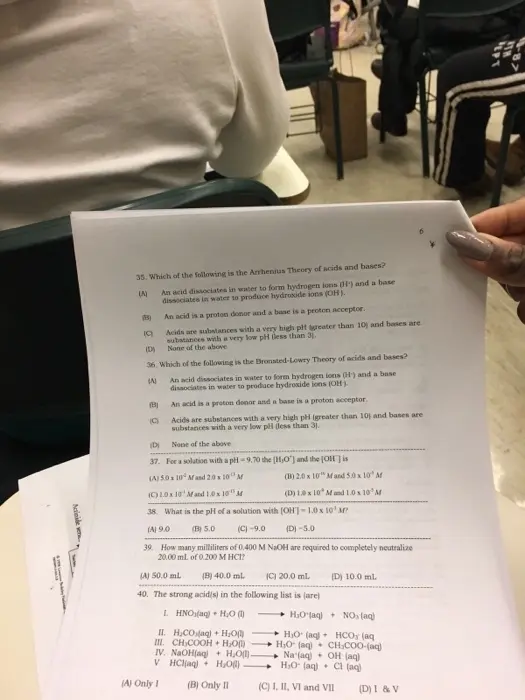
Transcribed Image Text:
35. Which of the following is the Arrhenius Theory of acids and bases?
(A)
An acid dissociates in water to form hydrogen ions (H) and a base
dissociates in water to produce hydroxide ions (OH).
B
An acid is a proton donor and a base is a proton acceptor.
19
ID
Acids are substances with a very high pH greater than 10) and bases are
substances with a very low pH less than 3.
None of the above.
36. Which of the following is the Bronsted-Lowry Theory of acids and bases?
IN
An acid dissociates in water to form hydrogen ions (H) and a base
dissociates in water to produce hydroxide ions (OH)
(B)
An acid is a proton donor and a base is a proton acceptor.
(C)
Acids are substances with a very high pH (greater than 10) and bases are
substances with a very low pH (less than 3).
D
None of the above
37. For a solution with a pH-9.70 the [H0] and the [OH] is
(A) 50s 10° Mand 20x10 M
(C) 1.0x 10' Mand 1.0x10
(B) 2.0 x 10 M and 5.0 x 10 M
(D)
10 x 10 M and 1.0 x 10 M
38. What is the pH of a solution with [OH]-1.0x 10' M
(A) 9.0
(B) 5.0
(C)-9.0
(D) -5.0
39. How many milliliters of 0.400 M NaOH are required to completely neutralize
20.00 ml of 0.200 M HCI?
(A) 50.0 mL
(B) 40.0 ml.
(C) 20.0 mL.
(D) 10.0 ml.
40. The strong acid(s) in the following list is (are)
L HNO3(aq) HO (1)
II. H,CO(aq) + H₂O
III. CH,COOH HO
IV. NaOH(aq) H₂O)-
V HCl(aq) + H₂O)
HO(aq) NO, (aq)
HO (aq) + HCO (aq
H,O (aq) CH,COO-(aq)
Na (aq)
HO (aq)
OH (aq)
Cl(aq)
(A) Only 1
(B) Only II
(C) I, II, VI and VII
(D) I & V
check_circle الجواب — حل مفصل خطوة بخطوة
hourglass_top
🔒
الحل الكامل متاح للمشتركين
اشترك في أرشيف الأسئلة لعرض هذا الحل وآلاف الحلول المفصلة خطوة بخطوة من معلمين معتمدين.