تم الحل ✓
categoryالفيزياء
schoolبكالوريوس
event_available2026-07-15
السؤال
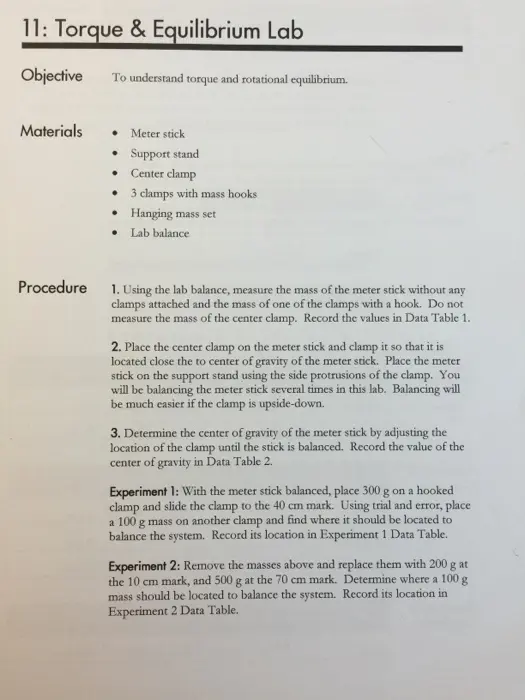
Transcribed Image Text:
11: Torque & Equilibrium Lab
Objective To understand torque and rotational equilibrium.
Materials · Meter stick
• Support stand
•
Center clamp
3 clamps with mass hooks
Hanging mass set
Lab balance
Procedure
1. Using the lab balance, measure the mass of the meter stick without any
clamps attached and the mass of one of the clamps with a hook. Do not
measure the mass of the center clamp. Record the values in Data Table 1.
2. Place the center clamp on the meter stick and clamp it so that it is
located close the to center of gravity of the meter stick. Place the meter
stick on the support stand using the side protrusions of the clamp. You
will be balancing the meter stick several times in this lab. Balancing will
be much easier if the clamp is upside-down.
3. Determine the center of gravity of the meter stick by adjusting the
location of the clamp until the stick is balanced. Record the value of the
center of gravity in Data Table 2.
Experiment 1: With the meter stick balanced, place 300 g on a hooked
clamp and slide the clamp to the 40 cm mark. Using trial and error, place
a 100 g mass on another clamp and find where it should be located to
balance the system. Record its location in Experiment 1 Data Table.
Experiment 2: Remove the masses above and replace them with 200 g at
the 10 cm mark, and 500 g at the 70 cm mark. Determine where a 100 g
mass should be located to balance the system. Record its location in
Experiment 2 Data Table.
Data
Experiment 3: Remove the masses used in the step above. Place the
center clamp at the 30 cm mark. Add a 200 g mass on the meter stick and
determine where it should be placed to balance the system. Record its
location in Experiment 3 Data Table.
Experiment 4: Remove the masses used in the step above. Keep the
center clamp at the 30 cm mark. Add a 300 g mass at the 40 cm mark,
and determine where a 500 g mass must be placed to balance the system.
Record that value in Experiment 4 Data Table.
Data Table 1
Object
Mass
Meter stick
101.49
Clamp
19.99
Data Table 2
Meter Stick Center of Gravity
50cm
Experiment 1
Data Table
Mass
Mass of clamp (g) Total Mass (kg) Location
300 g
100 g
23.39
23.
0.3233kg
0.1233k
40 cm
76.5cm
Experiment 2
Data Table
Mass
Mass of clamp (g) Total Mass (kg)
Location
200 g
23.3
0.2233k
10 cm
500 g
23.79
0.5233g
70 cm
100 g
23.3
0.1233
36cm
Experiment 3
Data Table
Mass
Mass of clamp (g) Total Mass (kg)
Location
200 g
23.3
0.2233g
20.6cm
56
Experiment 4
Data Table
Mass of clamp (g) Total Mass (kg) Location
Mass
300 g
23.3g
23.3g
500 g
0.3233
0.5233
40 cm
19.8en
Calculations For useful formulas, see Appendix A.
1. For each of the data tables above, insert the mass of the clamp and
calculate the total mass of the hanging mass plus clamp in kilograms.
2. For each mass, calculate the lever arm as the distance of the weight
from the point of rotation. Record the value in meters in the Calculation
tables below.
Experiment 1: (Determination of the 100 g lever arm)
a. Calculate the experimental lever arm by finding the distance of the 100 g
mass from the axis of rotation as found in your experiment.
b. Calculate the theoretical lever arm by performing a sum of torques
equation. All weights on one side of the axis of rotation are clockwise
torques, and all weights on the opposite side of the axis are
counterclockwise torques. The sum of all torques should be zero. For
this case, consider the lever arm of the 100 g mass as the unknown. Write
the sum of torques equation and show your work in the space provided.
Note: Remember to include the mass of the clamp when necessary and
use weights in your calculation (not masses).
c. Calculate the percent error between the experimentally determined
lever arm and your calculated value.
Experiment 2: (Determination of the 100 g lever arm)
a. Calculate the experimental lever arm by finding the distance of the 100 g
mass from the axis of rotation as found in your experiment.
b. Calculate the theoretical lever arm by performing a sum of torques
equation. All weights on one side of the axis of rotation are clockwise
torques, and all weights on the opposite side of the axis are
counterclockwise torques. The sum of all torques should be zero. For
this case, consider the lever arm of the 100 g mass as the unknown. Write
the sum of torques equation and show your work in the space provided.
Note: Remember to include the mass of the clamp when necessary and
use weights in your calculation (not masses).
c. Calculate the percent error between the experimentally determined
lever arm and your calculated value.
Note: Remember to include the mass of the clamp when necessary and
use weights in your calculation (not masses).
Experiment 3: (Determination of the 200 g lever arm)
a. Calculate the experimental lever arm by finding the distance of the 200 g
mass from the axis of rotation as found in your experiment.
b. Calculate the theoretical lever arm by performing a sum of torques
equation. In this case, remember to consider the weight of the meter
stick. We can consider the weight to be concentrated at the center of
mass.
c. Calculate the percent error between the experimentally determined
lever arm and your calculated value.
Experiment 4: (Determination of the 500 g lever arm)
a. Calculate the experimental lever arm by finding the distance of the 500 g
mass from the axis of rotation as found in your experiment.
b. Calculate the theoretical lever arm by performing a sum of torques
equation. Again, remember to consider the weight of the meter stick.
c. Calculate the percent error between the experimentally determined
lever arm and your calculated value.
.50m
J
Experiment 1
Calculation
Table
Sum of Torques Equation
M₂-01233
que (2) Force & lever an
(2018-03
X=0.262206002
>=(+1)
Text = T-Ty=0
(0.3233)()()
42-(424)
= 0.316824-1.20834X
Peams of
7626-74.5
725
Experiment 2
Calculation
Table
M=0.227
626 Mas 0.5233
P100%
P-1.065373772
Theoretical Lever Arm Experimental Lever Arm Percent Error
0.262206002
0.265-
-1.065873779
Sum of Torques Equation
Tag (7) = For Lon
The T-T-40
y= 0.1233
Tu migh-h
(82) (2) - (0.12.13)(+0)x
Top (0.875306)-(0)-(1.2034)x
Per E
(0,1244 (2)-(&)
(
0.2014) (0.878336-|-(1-025668) Row
X=-0.124412 002m.
Theoretical Lever Arm Experimental Lever Arm
0.124412003
0.1400
Percent Error
12.5293353%
59
09
60
Experiment 3
Calculation
Table
M₁-0.2221
-9300-
40206
0.078
Experiment 4
Calculation
Table
Sum of Torques Equation
Theoretical Lever Arm Experimental Lever Arm Percent Error
Sum of Torques Equation
Theoretical Lever Arm Experimental Lever Arm Percent Error
Questions
Answer the following post-lab questions. See "Good Lab Practices" on
page 1.
1. What are the requirements for an object to be in static equilibrium?
⑦
2. If an object is in equilibrium, describe its motion.
3. You did not measure the mass of the center clamp. Why is this
information not needed to compute the torque values?
4. For the first experiment, determine the force with which the support
pushes up.
5. Discuss the accuracy of each experiment using your percent error
values. Give reasons for your error.
61
check_circle الجواب — حل مفصل خطوة بخطوة
hourglass_top
🔒
الحل الكامل متاح للمشتركين
اشترك في أرشيف الأسئلة لعرض هذا الحل وآلاف الحلول المفصلة خطوة بخطوة من معلمين معتمدين.