تم الحل ✓
categoryاقتصاد عام
schoolبكالوريوس
event_available2026-07-15
السؤال
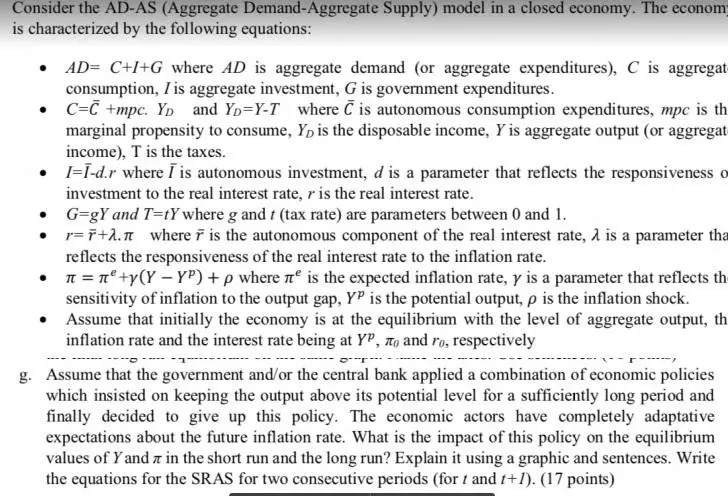
Transcribed Image Text:
Consider the AD-AS (Aggregate Demand-Aggregate Supply) model in a closed economy. The economy
is characterized by the following equations:
• AD= C+I+G where AD is aggregate demand (or aggregate expenditures), C is aggregat
consumption, I is aggregate investment, G is government expenditures.
•C=C+mpc. YD and YD-Y-T where C is autonomous consumption expenditures, mpc is th
marginal propensity to consume, Yo is the disposable income, Y is aggregate output (or aggregat
income), T is the taxes.
• I-I-d.r where I is autonomous investment, d is a parameter that reflects the responsiveness o
investment to the real interest rate, r is the real interest rate.
⚫ G=gy and T=tY where g and t (tax rate) are parameters between 0 and 1.
•
r=+λ.π where is the autonomous component of the real interest rate, λ is a parameter tha
reflects the responsiveness of the real interest rate to the inflation rate.
• π=π² +у(Y-YP) + p where л is the expected inflation rate, y is a parameter that reflects the
sensitivity of inflation to the output gap, YP is the potential output, p is the inflation shock.
⚫ Assume that initially the economy is at the equilibrium with the level of aggregate output, th
inflation rate and the interest rate being at YP, to and ro, respectively
g. Assume that the government and/or the central bank applied a combination of economic policies
which insisted on keeping the output above its potential level for a sufficiently long period and
finally decided to give up this policy. The economic actors have completely adaptative
expectations about the future inflation rate. What is the impact of this policy on the equilibrium
values of Y and in the short run and the long run? Explain it using a graphic and sentences. Write
the equations for the SRAS for two consecutive periods (for 1 and 1+1). (17 points)
check_circle الجواب — حل مفصل خطوة بخطوة
hourglass_top
🔒
الحل الكامل متاح للمشتركين
اشترك في أرشيف الأسئلة لعرض هذا الحل وآلاف الحلول المفصلة خطوة بخطوة من معلمين معتمدين.