تم الحل ✓
categoryالإدارة والاقتصاد
schoolبكالوريوس
event_available2026-07-15
السؤال
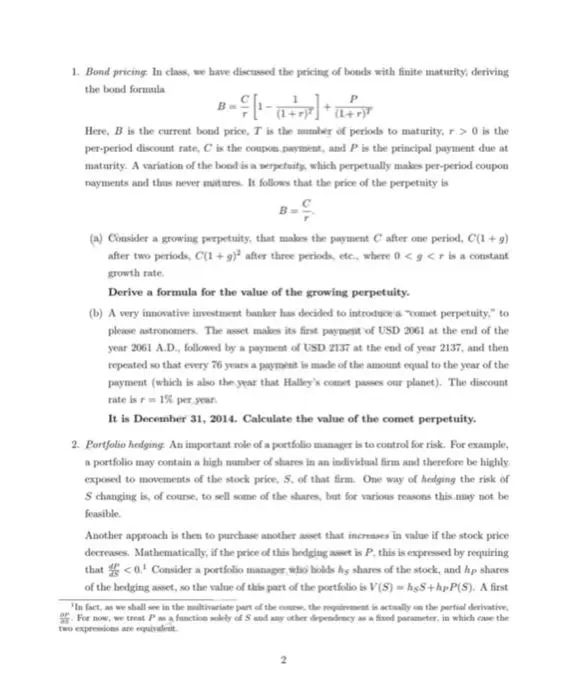
Transcribed Image Text:
1. Bond pricing In class, we have discussed the pricing of bonds with finite maturity, deriving
the bond formula
Here, B is the current bond price, T is the number of periods to maturity, r > 0 is the
per-period discount rate, C is the coupon payment, and P is the principal payment due at
maturity. A variation of the bond is a serpetuity, which perpetually makes per-period coupon
nayments and thus never matures. It follows that the price of the perpetuity is
B-
(a) Consider a growing perpetuity, that makes the payment C after one period, C(1+9)
after two periods, C(1+9) after three periods, etc., where 0<g<r is a constant
growth rate.
Derive a formula for the value of the growing perpetuity.
(b) A very innovative investment banker has decided to introduce a "comet perpetuity," to
please astronomers. The asset makes its first payment of USD 2061 at the end of the
year 2061 A.D., followed by a payment of USD 2137 at the end of year 2137, and then
repeated so that every 76 years a payment is made of the amount equal to the year of the
payment (which is also the year that Halley's comet passes our planet). The discount
rate is r=1% per year.
It is December 31, 2014. Calculate the value of the comet perpetuity.
2. Portfolio hedging. An important role of a portfolio manager is to control for risk. For example,
a portfolio may contain a high number of shares in an individual firm and therefore be highly
exposed to movements of the stock price, S. of that firm. One way of hedging the risk of
S changing is, of course, to sell some of the shares, but for various reasons this may not be
feasible.
a
Another approach is then to purchase another asset that increases in value if the stock price
decreases. Mathematically, if the price of this hedging asset is P, this is expressed by requiring
that <0. Consider a portfolio manager, who holds hy shares of the stock, and hp shares
of the hedging asset, so the value of this part of the portfolio is V(S)-heS+hpP(S). A first
In fact, as we shall see in the multivariate part of the course, the requirement is actually on the partial derivative
For now, we treat P as a function solely of S and any other dependency as a fixed parameter, in which case the
two expressions are equivalent
2
order Taylor expansion of the portfolio value around S shows that if the stock price moves
to S+AS, then the portfolio value moves to approximately V(S+AS) = hs(S+AS) +
hp (P(S)+AS), so the change in value is approximately (hs+hp) AS. Technically,
AS|≤ C(AS)²
V(S+AS)-V(S)-(hs+hp
-(hs + hp) AS| S
for some constant C>0.
(1)
We define the number A, which is denoted by the "delta" of the hedging asset (with
respect to stock price risk). A delta hedge is implemented by purchasing an amount of the
hedging asset such that the portfolio is neutral to small movements of the stock price, i...
such that hy+hpAp=0. We arrive at
for the delta hedge, where positivity follows from the assumption that Ap <0, ie, that the
hedging asset's price increases when the stock price decreases. An equivalent formulation of
this hedge is of course that he is chosen such that V'(S)-0.
(a) The classical Black-Scholes formula for the price, Pr, of a so-called put option on the
stock with strike price Kis
where
Px(S)-K1-N(z-a√T)]-S[1-N(2)],
In(S/K)+(+³/2)T
Here, r is the instantaneous discount rate, is the stock's return volatility, and 7 is
the time to maturity, all of which, together with K, are treated as constants so that
Pk is viewed as a function of a single variable, S. The function N(z) is the so-called
cumulative distribution function of the standard normal distribution, a strictly positive
increasing function with range between zero and one, with the important property that
N'(x)=
√2
We will discuss options and the cumulative normal distribution in some further detail
later in the course, but this is sufficient for the current exercise. Finally, In() is the
natural logarithm of z,
z
Derive the following formula for the delta of the put option: Ar-N(r) -1.
(b) As we know from class, an even better approximation of a function around a point is
obtained by a second order Taylor expansion. The portfolio management equivalence of
this principle is the use of a delta-gamma hedge. Technically, the holdings in the assets
are chosen such that V'(S)=0, and V"(S)=0, leading to an error of the order (AS)³
for small AS.
Define the gamma of an asset p = and note, of course, that the stock's gamma is
Is=0.
Derive the following formula for the gamma of the put option: FPS
N'()
(e) To create a delta-gamma hedge, two put options are needed. Consider a portfolio with
he shares, hi put options with strike price K₁, and h₂ options with strike price K₂ (and
the same r, a, and T).
Use Taylor's formula to derive expressions for h₁ and h₂ in the delta-gamma
neutral hedge, as a function of AP, APK IP, and IP₂
1. Bond pricing. In class, we have discussed the pricing of bonds with finite maturity, deriving
the bond formula
P
A[raba] ਗਾ
(1+r)
Here, B is the current bond price, T is the number of periods to maturity, r> 0 is the
per-period discount rate, C is the coupon payment, and P is the principal payment due at
maturity. A variation of the bond is a serpetuity, which perpetually makes per-period coupon
payments and thus never matures. It follows that the price of the perpetuity is
B=
(a) Consider a growing perpetuity, that makes the payment C after one period, C(1+g)
after two periods, C(1+9) after three periods, etc., where 0 <g<r is a constant
growth rate.
Derive a formula for the value of the growing perpetuity.
(b) A very innovative investment banker has decided to introduce a "comet perpetuity," to
please astronomers. The asset makes its first payment of USD 2061 at the end of the
year 2061 A.D., followed by a payment of USD 2137 at the end of year 2137, and then
repeated so that every 76 years a payment is made of the amount equal to the year of the
payment (which is also the year that Halley's comet passes our planet). The discount
rate is r 1% per year.
It is December 31, 2014. Calculate the value of the comet perpetuity.
2. Portfolio hedging. An important role of a portfolio manager is to control for risk. For example,
a portfolio may contain a high number of shares in an individual firm and therefore be highly
exposed to movements of the stock price, S, of that firm. One way of hedging the risk of
S changing is, of course, to sell some of the shares, but for various reasons this may not be
feasible.
Another approach is then to purchase another asset that increases in value if the stock price
decreases. Mathematically, if the price of this hedging asset is P, this is expressed by requiring
that <0. Consider a portfolio manager who holds he shares of the stock, and hp shares
of the hedging asset, so the value of this part of the portfolio is V(S)=hsS+hpP(S). A first
'In fact, as we shall see in the multivariate part of the course, the requirement is actually on the partial derivative,
For now, we treat P as a function solely of S and any other dependency as a fixed parameter, in which case the
wo expressions are equivalent.
order Taylor expansion of the portfolio value around S shows that if the stock price moves
to S+AS, then the portfolio value moves to approximately V(S+AS) hs(S+AS) +
hp (P(S)+AS), so the change in value is approximately (hs+hp) AS. Technically,
V(S+AS)-V(S)-(hs+hp) AS| ≤ C(AS)?
for some constant C > 0.
(1)
We define the number Ap, which is denoted by the "delta" of the hedging asset (with
respect to stock price risk). A delta hedge is implemented by purchasing an amount of the
hedging asset such that the portfolio is neutral to small movements of the stock price, ie.,
such that hs+hpAp=0. We arrive at
hp
for the delta hedge, where positivity follows from the assumption that Ap <0, ie., that the
hedging asset's price increases when the stock price decreases. An equivalent formulation of
this hedge is of course that hp is chosen such that V"(S)=0.
(a) The classical Black-Scholes formula for the price, Pk. of a so-called put option on the
stock with strike price Kis
where
Px(S)-Ke-[1-N(z-a√T)]-5|1-N(x)],
In(S/K)+(r+02/2)T
OVI
Here, r is the instantaneous discount rate, or is the stock's return volatility, and T is
the time to maturity, all of which, together with K, are treated as constants so that
Pic is viewed as a function of a single variable, S. The function N(z) is the so-called
cumulative distribution function of the standard normal distribution, a strictly positive
increasing function with range between zero and one, with the important property that
N'(x)=
We will discuss options and the cumulative normal distribution in some further detail
later in the course, but this is sufficient for the current exercise. Finally, In(z) is the
natural logarithm of x, en().
Derive the following formula for the delta of the put option: Ap = N(r) -1.
(b) As we know from class, an even better approximation of a function around a point is
obtained by a second order Taylor expansion. The portfolio management equivalence of
this principle is the use of a delta-gamma hedge. Technically, the holdings in the assets
are chosen such that V'(S)=0, and V"(S)=0, leading to an error of the order (AS)³
for small AS.
Define the gamma of an asset Ip = and note, of course, that the stock's gamma is
r's=0.
N'(z)
SevT
Derive the following formula for the gamma of the put option: IP
(e) To create a delta-gamma hedge, two put options are needed. Consider a portfolio with
he shares, hi put options with strike price K₁, and h₂ options with strike price K₂ (and
the same r, a, and T).
Use Taylor's formula to derive expressions for h₁ and h₂ in the delta-gamma
neutral hedge, as a function of AP, APK, TP, and IP"
1. Bond pricing. In class, we have discussed the pricing of bonds with finite maturity, deriving
the bond formula
1+r)7
P
(1+r)
Here, B is the current bond price, T is the number of periods to maturity, r > 0 is the
per-period discount rate, C is the coupon payment, and P is the principal payment due at
maturity. A variation of the bond is a perpetuity, which perpetually makes per-period coupon
payments and thus never matures. It follows that the price of the perpetuity is
B=
(a) Consider a growing perpetuity, that makes the payment C after one period, C(1+g)
after two periods, C(1+g)2 after three periods, etc., where 0 <g<r is a constant
growth rate.
Derive a formula for the value of the growing perpetuity.
(b) A very innovative investment banker has decided to introduce a "comet perpetuity," to
please astronomers. The asset makes its first payment of USD 2061 at the end of the
year 2061 A.D., followed by a payment of USD. 2137 at the end of year 2137, and then
repeated so that every 76 years a payment is made of the amount equal to the year of the
payment (which is also the year that Halley's comet passes our planet). The discount
rate is r 1% per year.
It is December 31, 2014. Calculate the value of the comet perpetuity.
2. Portfolio hedging. An important role of a portfolio manager is to control for risk. For example,
a portfolio may contain a high number of shares in an individual firm and therefore be highly
exposed to movements of the stock price, S, of that firm. One way of hedging the risk of
S changing is, of course, to sell some of the shares, but for various reasons this may not be
feasible.
Another approach is then to purchase another asset that increases in value if the stock price
decreases. Mathematically, if the price of this hedging asset is P, this is expressed by requiring
that <0. Consider a portfolio manager who holds he shares of the stock, and hp shares
of the hedging asset, so the value of this part of the portfolio is V(S)=hsS+hpP(S). A first
In fact, as we shall see in the multivariate part of the course, the requirement is actually on the partial derivative,
For now, we treat P as a function solely of S and any other dependency as a fixed parameter, in which case the
two expressions are equivalent.
2
order Taylor expansion of the portfolio value around S shows that if the stock price moves
to S+AS, then the portfolio value moves to approximately V(S+AS) hs(S+AS) +
hp (P(S)+AS), so the change in value is approximately (hs + hp) AS. Technically,
|V(S+AS)-V(S)-(hs + hp) AS| ≤ C(AS)².
for some constant C>0.
(1)
We define the number Ap, which is denoted by the "delta" of the hedging asset (with
respect to stock price risk). A delta hedge is implemented by purchasing an amount of the
hedging asset such that the portfolio is neutral to small movements of the stock price, i.e.,
such that he + hpAp=0. We arrive at
hp
>0
Ap
for the delta hedge, where positivity follows from the assumption that Ap <0, ie., that the
hedging asset's price increases when the stock price decreases. An equivalent formulation of
this hedge is of course that hp is chosen such that V'(S)=0.
for the delta hedge, where positivity follows from the assumption that Ap <0, ie, that the
bedging asset's price increases when the stock price decreases. An equivalent formulation of
this hedge is of course that hp is chosen such that "(S)-0.
(a) The classical Black-Scholes formula for the price, Pk. of a so-called put option on the
stock with strike price Kis
where
Pk(S)-Ke-1-N-T)]-5|1-N(2)].
In(S/K)+(r+²/2)T
Here, is the instantaneous discount rate, is the stock's return volatility, and T is
the time to maturity, all of which, together with K. are treated as constants so that
Pk is viewed as a function of a single variable, S. The function N(2) is the so-called
cumulative distribution function of the standard normal distribution, a strictly positive
increasing function with range between zero and one, with the important property that
N'(x)=
We will discuss options and the cumulative normal distribution in some further detail
later in the course, but this is sufficient for the current exercise. Finally, In(r) is the
natural logarithm of z,
z
Derive the following formula for the delta of the put option: Any -N()-1.
(b) As we know from class, an even better approximation of a function around a point is
obtained by a second order Taylor expansion. The portfolio management equivalence of
3
this principle is the use of a delta-gamma hedge. Technically, the holdings in the assets
are chosen such that V(S)=0, and V"(S)-0, leading to an error of the order (AS)³
for small AS.
Define the gamma of an asset p= and note, of course, that the stock's gamma is
N°)
Derive the following formula for the gamma of the put option: Fry= Sev
(e) To create a delta-gamma hedge, two put options are needed. Consider a portfolio with
hg shares, hy put options with strike price Ky, and by options with strike price K₁ (and
the same r, e, and T)
Use Taylor's formula to derive expressions for h; and by in the delta-gamma
neutral hedge, as a function of An Anand
check_circle الجواب — حل مفصل خطوة بخطوة
hourglass_top
🔒
الحل الكامل متاح للمشتركين
اشترك في أرشيف الأسئلة لعرض هذا الحل وآلاف الحلول المفصلة خطوة بخطوة من معلمين معتمدين.