تم الحل ✓
categoryالهندسة الكهربائية
schoolبكالوريوس
event_available2026-07-15
السؤال
Transcribed Image Text:
224
Optical Fiber Communications
a
a
Common-core
area
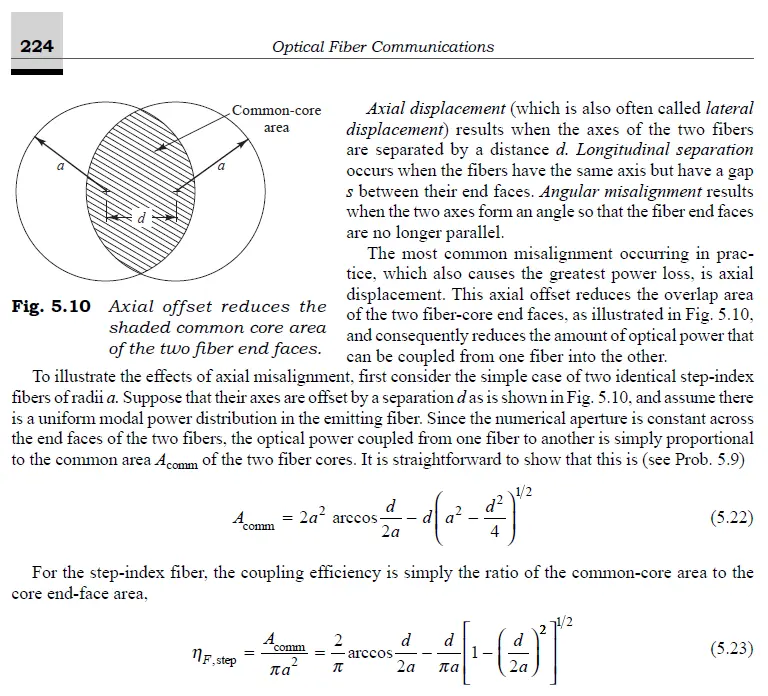
Axial displacement (which is also often called lateral
displacement) results when the axes of the two fibers
are separated by a distance d. Longitudinal separation
occurs when the fibers have the same axis but have a gap
s between their end faces. Angular misalignment results
when the two axes form an angle so that the fiber end faces
are no longer parallel.
The most common misalignment occurring in prac-
tice, which also causes the greatest power loss, is axial
displacement. This axial offset reduces the overlap area
of the two fiber-core end faces, as illustrated in Fig. 5.10,
and consequently reduces the amount of optical power that
can be coupled from one fiber into the other.
Fig. 5.10 Axial offset reduces the
shaded common core area
of the two fiber end faces.
To illustrate the effects of axial misalignment, first consider the simple case of two identical step-index
fibers of radii a. Suppose that their axes are offset by a separation d as is shown in Fig. 5.10, and assume there
is a uniform modal power distribution in the emitting fiber. Since the numerical aperture is constant across
the end faces of the two fibers, the optical power coupled from one fiber to another is simply proportional
to the common area A comm of the two fiber cores. It is straightforward to show that this is (see Prob. 5.9)
d²
A
= 2a² arccos-
comm
d
2a
- da² - 4212
4
(5.22)
For the step-index fiber, the coupling efficiency is simply the ratio of the common-core area to the
core end-face area,
NF.step
=
=-arccos.
A
2
comm
2
πα
元
d d
1
-
2a πα
2a
(5.23)
check_circle الجواب — حل مفصل خطوة بخطوة
hourglass_top
🔒
الحل الكامل متاح للمشتركين
اشترك في أرشيف الأسئلة لعرض هذا الحل وآلاف الحلول المفصلة خطوة بخطوة من معلمين معتمدين.