تم الحل ✓
categoryالإدارة والاقتصاد
schoolبكالوريوس
event_available2026-07-15
السؤال
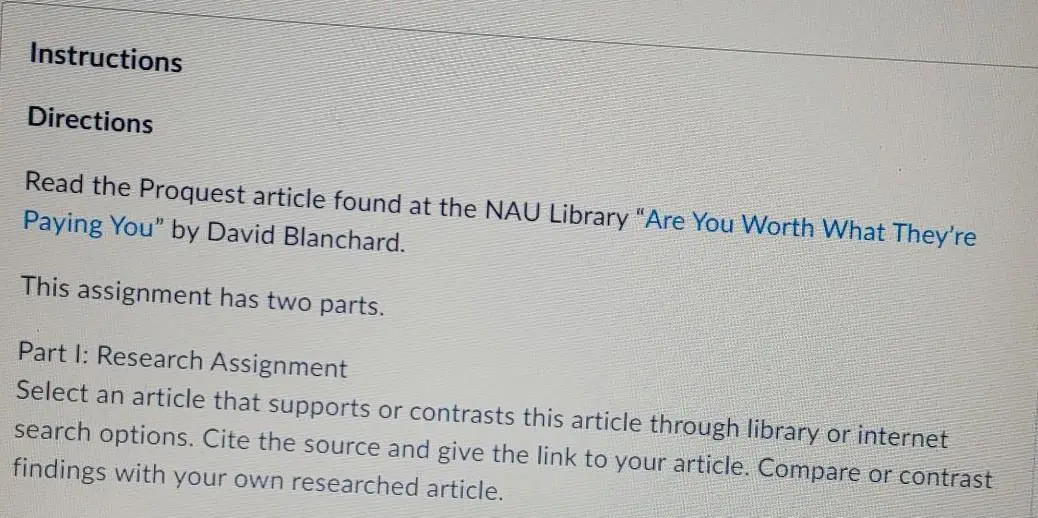
Transcribed Image Text:
Instructions
Directions
Read the Proquest article found at the NAU Library "Are You Worth What They're
Paying You" by David Blanchard.
This assignment has two parts.
Part I: Research Assignment
Select an article that supports or contrasts this article through library or internet
search options. Cite the source and give the link to your article. Compare or contrast
findings with your own researched article.
Abstract
Translate
While the average annual salary of manufacturing managers in the US basically remained flat over the past year (salaries dipped
by 0.9%, from $106,588 in 2007 to $105,581 in 2008), the percentage of managers who are "very satisfied" or "satisfied" with
manufacturing as a career path actually increased by 4% this year (from 79% to 83 %). That's just one of many "believe it or not"
findings uncovered in IndustryWeek's 2008 salary survey. Managers in the automotive industry ($94,399) and wood
products/furniture makers ($90,862) - two industries that have been hit particularly hard by foreign competition - brought up the
rear with the lowest average salaries. The good news is that the average salary for a female manufacturing manager rose $7,698
compared to last year's survey, representing a 10.6% jump. The bad news is that the percent of women in management positions
dropped from 12% of the total a year ago to 10% this year.
0:00/0:00
INDUSTRY WEEK'S EXCLUSIVE 2008 SALARY SURVEY REVEALS THAT THE AVERAGE SALARY FOR MANUFACTURING
MANAGEMENT IS $105,581.
"Manufacturing is a cut-throat world, margins are shrinking, energy costs are rising, stockholders are whining, and the resources
that keep the wheels on the cart are suffering, as a manager i see the need to return to my blue-collar roots and appreciate the
blood and sweat that is donated to capitalism"-production manager with a plastics/rubber manufacturer with 6-10 years of
experience, living in the Middle Atlantic region and earning $55,000
"In the next few years, the manufacturers in this country will be the best in the world or they'll be gone" - corporate/executive
manager of a plastics/rubber manufacturer, with 20-25 years of experience, living in the Mountain region and earning $130,000
"I am pleased to work for my management due to their recognition of the working people in the factory, regardless of level. we are
all valued and those of us in management are regularly recognized and thanked for the effort we expend on behalf of the
company's success. we hire with an eye toward the promotability of the new hire. it is very important for america to raise the
standard of working labor positions and support the U.S. manufacturing industry" operations manager at a food & beverage
producer, with 26+ years of experience, living in the North Central region and earning $140,000
"Manufacturing is finished in the united states. R.I.P" engineering manager with a computer equipment manufacturer, with 26+
years of experience, living in the North Central region and earning $55,000
TO UNDERSTAND THE STATE OF manufacturing in the united states, you need to recognize it as a study in contradictions. the
number of people employed in manufacturing, for instance, continues to decline (with an annual rate of change projected at -1.1%
over the next 10 years), and yet output and overall productivity improve every year. Low-cost goods imported from overseas are
believed to be threatening the very existence of U.S. manufacturing, but in fact the rise in the number of exports from the united
states indicates that as global economies grow, so too does the profitability of american manufacturers
And closer to home, while the average annual salary of manufacturing managers in the united states basically remained flat over
the past year (salaries dipped by 0.9%, from $106,588 in 2007 to $105,581 in 2008), the percentage of managers who are "very
satisfied" or "satisfied" with manufacturing as a career path actually increased by 4% this year (from 79% to 83%).
That's just one of many "believe it or not" findings we uncovered in IndustryWeek's 2008 salary survey. nearly 1,350 readers
weighed in, and thanks to the anonymous nature of the survey, they revealed not only how much they earn, what kind of
companies they work for and their level of experience, but also what matters most to them about their job, the biggest challenges
confronting the industry, and even their frustrations and hopes for the days to come. they didn't just tell us what they do, but also
why they do it.
Once we crunched all the numbers from the survey results, we discovered that the "average manufacturing manager" is a white
male, between 50-59 years old, has worked in the manufacturing industry for more than 26 years, lives in the north Central region
of the united states (ie, the Midwest), has been with his current company for six to 10 years, has a bachelor's degree, works for a
metals producer, and earns $105,581 But of course, there's no "one size fits all" description that can really illustrate the day-to-day
doings of manufacturing managers, so to bring all these facts and figures to life, you'll find a running commentary on the industry
from the men and women whose job it is to make sure things get made the right way.
What Do You Do?
"Imports are killing the furniture industry"-corporate/executive manager at a building products manufacturer, with 11-15 years of
experience, living in the Middle Atlantic region and earning $90,000
"In the automotive industry the players are becoming less numerous so we will probably see less innovation as the wagons are
circled, there must be a renewed trust and investment in us manufacturing, this is not only an economic concern, but a potential
national security concern"-director of production at an automotive manufacturer, with 20-25 years of experience, living in the
South Central region and earning $120,000
"My company is in the semiconductor industry. our ceo has openly chastised our manufacturing operations on several occasions
so it does not take a rocket scientist to know he has little or no use for us. he would just as well see even more good paying jobs
go offshore." - production manager in the high-tech/electronics industry, with 26+ years of experience, living in the Mountain
region and earning $120,000
The idea of a manufacturing "industry" is actually something of a misnomer. for bureaucracy's sake, the u.s. Bureau of Labor
statistics ranks all goods-producing companies (excluding agriculture, mining and construction) as "manufacturing," so
companies that make toothpaste, diagnostic equipment, carburetors and MP3 players are all considered part of the overall
manufacturing industry, and in fact IndustryWeek's readership is similarly diverse. so one of the first things we set out to learn
was how many people work in each vertical industry, and what the average salary is for each industry.
More manufacturing managers work in the metals industry (12%) than any other industry, followed by automotive/transportation
vehicle manufacturers (10%) and industrial machinery producers (9%) at the opposite end are manufacturers of computer
equipment and peripherals, as only 1% of the respondents work in that area; there could be some overlap, though, as 6% say they
work in the electronics/high-tech field.
According to last year's salary survey, the best-paid manufacturing managers were in the petroleum & coal sector, which given the
record profits many oil companies have been reporting didn't come as much of a surprise, this year, managers at
pharmaceutical/healthcare manufacturers-perhaps the only sector whose merits are scrutinized by the popular press and political
office-seekers more than the oil companies-have captured the top spot for largest average salary ($137,010). Petroleum
managers slipped all the way to sixth place.
Meanwhile, managers in the automotive industry ($94,399) and wood products/furniture makers ($90,862)-two industries that
have been hit particularly hard by foreign competition-brought up the rear with the lowest average salaries.
Following the Sun
"I derive immense satisfaction from managing a successful and growing operation in central illinois, so much for the rust Belt." -
plant manager at a paper manufacturer, with 16-20 years of experience, living in the North Central region and earning $107,500
"Illinois companies are struggling because of many state government regulations, taxes, etc., that make it impossible to remain
competitive."-director of training with a consulting organization, with 6-10 years of experience, living in the North Central region
and earning $50,000
"We are not in the industrial loop. we are located in a small, quiet town, this does not allow much competition for salaries.
however, it does allow for a great place to live and raise a family individuals have to weigh those options"-production manager
with an aerospace & defense manufacturer, with 2-5 years of experience, living in the South Central region and earning $60,000
"Our purchasing department is being moved from california to Georgia. there are five people who will lose their jobs - all due to the
housing industry"-purchasing director at a manufacturer of industrial tools, with 16-20 years of experience, living in the Pacific
region and earning $94,000
It somehow doesn't seem fair not only do people living on the West Coast and in the southeast enjoy the best weather, but they
earn the highest average salaries, too. Manufacturing managers in the Pacific region (mostly California) earn $116,035, while
those in the south atlantic earn $113,128 Conversely, the north Central region (the Midwest, aka "the rust Belt"), where 40% of all
manufacturing managers live, has the second-lowest average salary, at $100,752 only the south Central, which has the second-
largest number of manufacturing managers (16%) did worse, at $98,569
Adding insult to injury, average salaries in the Pacific and south atlantic regions both increased in the past year (gaining 0.9% and
17%, respectively), whereas the north Central and South Central regions both declined (dropping 3% and 2%, respectively).
It's Still a Man's World
It's Still a Man's World
"There remains a significant difference in male vs. female salaries in like-titled jobs, regardless of experience or background."-
female quality manager at an aerospace & defense manufacturer with 26+ years of experience, living in the Middle Atlantic region
and earning $65,000
"The glass ceiling for women is still intact"-female production manager at a metals producer with 26+ years of experience, living
in the North Central region and earning $78,000
"With all the focus on equal opportunity, as a white male i feel like i'm getting passed over"-male supply chain manager at an
electronics manufacturer with 11-15 years of experience, living in New England and earning $102,000
The good news is that the average salary for a female manufacturing manager rose $7,698 compared to last year's survey,
representing a 10.6% jump. the gender gap between men and women also narrowed slightly-a year ago men earned 35% more
than women, with the average difference amounting to nearly $40,000 this year, the difference is $27,620, and the gap is a
somewhat more modest 26%.
The bad news is that the percent of women in management positions dropped from 12% of the total a year ago to 10% this year.
You can explain this discrepancy any number of ways-for example, men on the average have worked in the manufacturing field, at
all levels, far longer than women-but there's no escaping the fact that the idea of "equal pay for equal work" has yet to truly take
root in manufacturing
Generation Gap
"I am concerned about our failing education system to regain our competitive advantage sweeping adjustments must be made
immediately our educational institutions must partner with industry, allowing american industry to compete with the rest of the
world"-plant manager at a manufacturer of construction/building equipment, with 26+ years of experience, living in the North
Central region and earning $110,000
"$50k salary out of college with a 2.2 GPa - not too shabby"- engineering manager at an industrial coatings manufacturer, with
less than 2 years of experience, living in the South Central region and earning $50,000
"Experienced people are being viewed as cost reduction opportunities."-director of purchasing at a manufacturer of plumbing
products, with 26+ years of experience, living in the North Central region and earning $100,000
"We must encourage those coming behind us that manufacturing is an honorable profession and that it is just as viable to be
successful by learning and proving yourself through production ranks as it is to step into the front office right out of college."-
operations manager at a paper manufacturer, with 16-20 years of experience, living in the South Central region and earning
$94,000
The most effective managers and executives are those who have an understanding of not only how their individual departments
or plants are operating, but how they fit into the performance of their entire supply chain, explain William V. fello, senior client
partner, and Peter everaert, regional market leader, with executive search firm Korn/ferry International top-performing managers
can explain how they have improved cycle time, order fulfillment or inventory turns, and they have the statistics to back it up, fello
and everaert note. "[they] know the exact impact their changes and improvements are delivering, and when there is a problem that
needs to be resolved fast"
Not surprisingly, these sorts of people are in rather short supply, and they come by their industry knowledge honestly: 71% of all
manufacturing managers have at least a bachelor's degree, 71% have more than 15 years of experience in the industry and 46%
have spent more than 10 years with their current employer and, as you might expect, the older and more experienced you are, the
better you're paid: Managers 60 or older earn the highest average salary, at $122,871, those with at least 20 years of experience
earn more than $115,000, and those with a doctorate degree earn $147,121
The flip side to these numbers is the big "uh oh" confronting us manufacturers-a dearth of young people entering the industry
only 3% of survey respondents are in their 20s, only 18% are under 40 and just 7% have been in the manufacturing industry for
less than five years. While part of that is no doubt due to the nature of the job itself-managing a department or a plant is certainly
not a responsibility to turn over to an untested rookie-there's no getting past the reality that attracting and retaining talent to the
field is one of the most pressing needs for manufacturers at companies of all sizes.
When asked the open-ended question, "What is the biggest challenge facing the manufacturing industry today? more than 22% of
all respondents pointed to labor shortages of one sort or another one respondent summed the problem up succinctly "aging
workforce with little interest by the younger generation in manufacturing."
The other big area of concern, reflected by the survey results, is the economy itself, as the one thing that matters most to
manufacturing managers about their job this year is job stability (20.8%), which ranked at no. 3 a year ago. Base salary (20.7%)
finished very close behind at no. 2, while "recognition of your importance to your company" came in third (16%).
To close out with a note of optimism, however, it's worth noting that the percentage of manufacturing managers who are very
satisfied or satisfied with the current job remains unchanged from a year ago: 74%. any time you can find three out of four people
who like their jobs, despite everything else going on, that's a clear sign that manufacturing managers are committed to their
profession and their industry; and while the naysayers are quite vocal in their doomsday predictions, their pessimism is very much
in the minority.
Word count: 2339
Copyright Penton Media, Inc. Mar 2008
check_circle الجواب — حل مفصل خطوة بخطوة
hourglass_top
🔒
الحل الكامل متاح للمشتركين
اشترك في أرشيف الأسئلة لعرض هذا الحل وآلاف الحلول المفصلة خطوة بخطوة من معلمين معتمدين.