تم الحل ✓
categoryالتاريخ
schoolبكالوريوس
event_available2026-07-15
السؤال
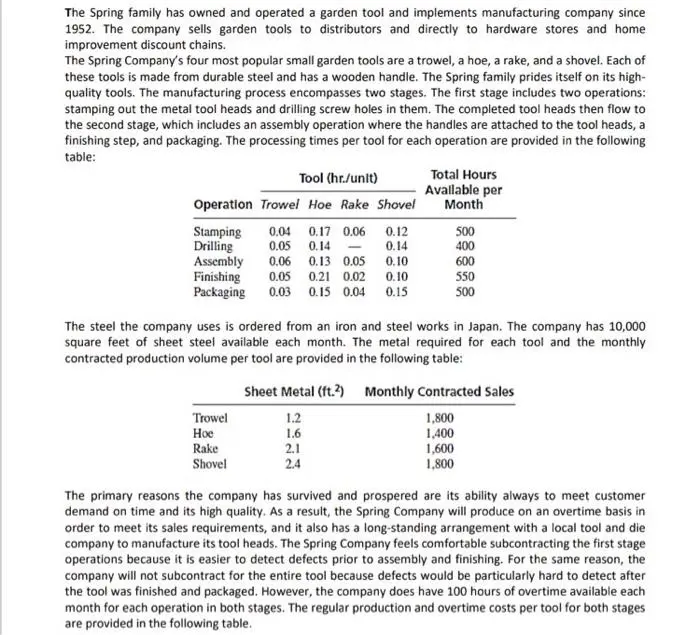
Transcribed Image Text:
The Spring family has owned and operated a garden tool and implements manufacturing company since
1952. The company sells garden tools to distributors and directly to hardware stores and home
improvement discount chains.
The Spring Company's four most popular small garden tools are a trowel, a hoe, a rake, and a shovel. Each of
these tools is made from durable steel and has a wooden handle. The Spring family prides itself on its high-
quality tools. The manufacturing process encompasses two stages. The first stage includes two operations:
stamping out the metal tool heads and drilling screw holes in them. The completed tool heads then flow to
the second stage, which includes an assembly operation where the handles are attached to the tool heads, a
finishing step, and packaging. The processing times per tool for each operation are provided in the following
table:
Tool (hr./unit)
Operation Trowel Hoe Rake Shovel
Total Hours
Available per
Month
Stamping
Drilling
0.04 0.17 0.06 0.12
500
0.05 0.14
-
0.14
400
Assembly 0.06 0.13 0.05
Finishing 0.05 0.21 0.02
Packaging 0.03 0.15 0.04
0.10
600
0.10
550
0.15
500
The steel the company uses is ordered from an iron and steel works in Japan. The company has 10,000
square feet of sheet steel available each month. The metal required for each tool and the monthly
contracted production volume per tool are provided in the following table:
Sheet Metal (ft.2) Monthly Contracted Sales
Trowel
1.2
Hoe
1.6
Rake
Shovel
2.1
2.4
1,800
1,400
1,600
1,800
The primary reasons the company has survived and prospered are its ability always to meet customer
demand on time and its high quality. As a result, the Spring Company will produce on an overtime basis in
order to meet its sales requirements, and it also has a long-standing arrangement with a local tool and die
company to manufacture its tool heads. The Spring Company feels comfortable subcontracting the first stage
operations because it is easier to detect defects prior to assembly and finishing. For the same reason, the
company will not subcontract for the entire tool because defects would be particularly hard to detect after
the tool was finished and packaged. However, the company does have 100 hours of overtime available each
month for each operation in both stages. The regular production and overtime costs per tool for both stages
are provided in the following table.
The cost of subcontracting in stage 1 adds 20% to the regular production cost. The Spring Company wants to
establish a production schedule for regular and overtime production in each stage and for the number of
tool heads subcontracted, at the minimum cost.
Formulate a linear programming model for this problem and solve the model using the computer.
Which resources appear to be most critical in the production process?
Stage 1
Stage 2
Regular
Overtime
Regular
Overtime
Cost
Cost
Cost
Cost
Trowel
$6.00
$6.20
$3.00
$3.10
Hoe
10.00
10.70
5.00
5.40
Rake
8.00
8.50
4.00
4.30
Shovel
10.00
10.70
5.00
5.40
Based on the above information answer the followings:
1. What will be the new objective value, and the decision variables if the subcontracted cost reached
40% of the regular production cost?
2. What will be the new objective value, and the decision variables if the provided steel quantity is
reduced to 7,000 square feet of sheet steel next month?
3. What will be the new objective value, and the decision variables if the provided steel quantity is
increased to 15,000, and 30,000 square feet of sheet steel next month? What is/are the bottleneck
resources to avoid subcontracting?
4. What will be the new objective value, and the decision variables if the overtime hours are increased
to 200 hrs. next month?
5. If the demand increased for all tools by 30%, can you still satisfy the demand, why?( explain your
answer)
check_circle الجواب — حل مفصل خطوة بخطوة
hourglass_top
🔒
الحل الكامل متاح للمشتركين
اشترك في أرشيف الأسئلة لعرض هذا الحل وآلاف الحلول المفصلة خطوة بخطوة من معلمين معتمدين.