تم الحل ✓
categoryهندسة مدنية
schoolبكالوريوس
event_available2026-07-15
السؤال
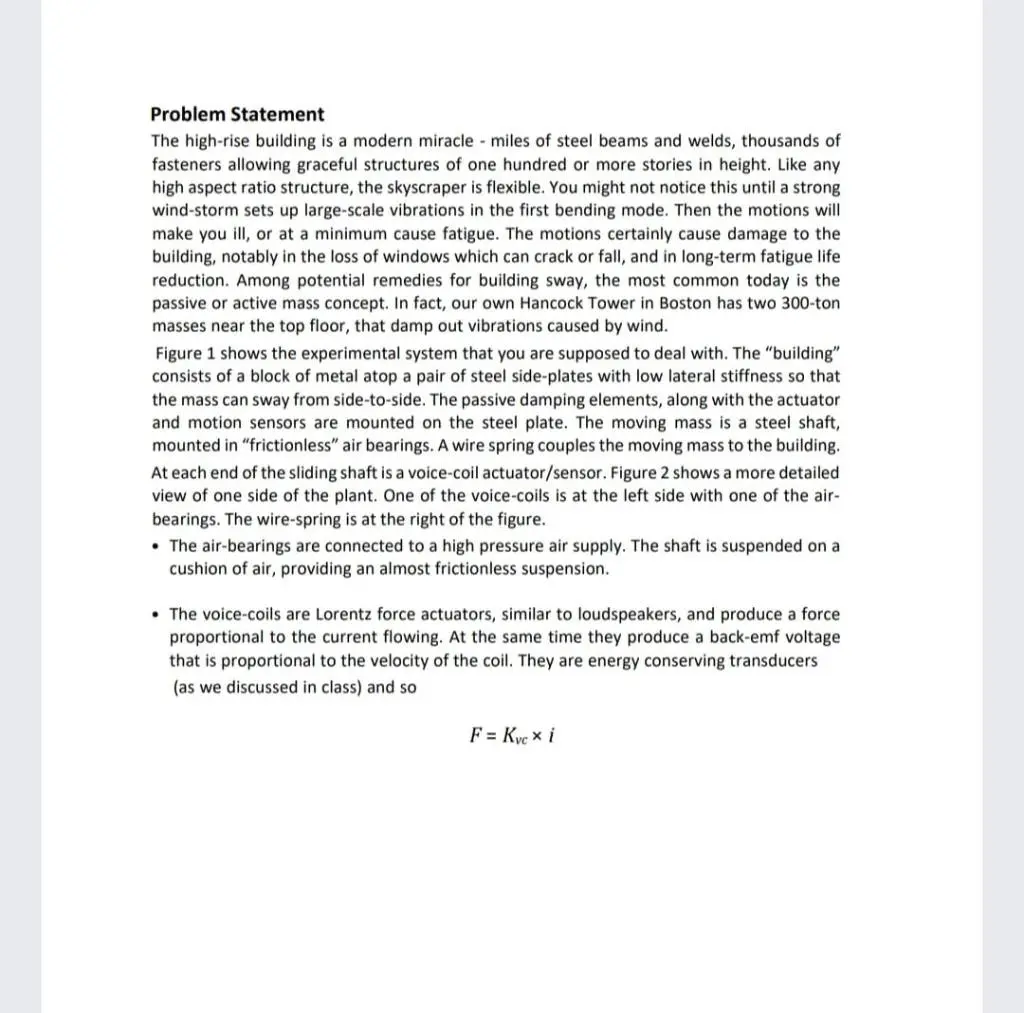
Transcribed Image Text:
Problem Statement
The high-rise building is a modern miracle miles of steel beams and welds, thousands of
fasteners allowing graceful structures of one hundred or more stories in height. Like any
high aspect ratio structure, the skyscraper is flexible. You might not notice this until a strong
wind-storm sets up large-scale vibrations in the first bending mode. Then the motions will
make you ill, or at a minimum cause fatigue. The motions certainly cause damage to the
building, notably in the loss of windows which can crack or fall, and in long-term fatigue life
reduction. Among potential remedies for building sway, the most common today is the
passive or active mass concept. In fact, our own Hancock Tower in Boston has two 300-ton
masses near the top floor, that damp out vibrations caused by wind.
Figure 1 shows the experimental system that you are supposed to deal with. The "building"
consists of a block of metal atop a pair of steel side-plates with low lateral stiffness so that
the mass can sway from side-to-side. The passive damping elements, along with the actuator
and motion sensors are mounted on the steel plate. The moving mass is a steel shaft,
mounted in "frictionless" air bearings. A wire spring couples the moving mass to the building.
At each end of the sliding shaft is a voice-coil actuator/sensor. Figure 2 shows a more detailed
view of one side of the plant. One of the voice-coils is at the left side with one of the air-
bearings. The wire-spring is at the right of the figure.
The air-bearings are connected to a high pressure air supply. The shaft is suspended on a
cushion of air, providing an almost frictionless suspension.
The voice-coils are Lorentz force actuators, similar to loudspeakers, and produce a force
proportional to the current flowing. At the same time they produce a back-emf voltage
that is proportional to the velocity of the coil. They are energy conserving transducers
(as we discussed in class) and so
F= Kvexi
Figure 1: The Experimental System:
Figure 2: Detailed view of the left-side of the building.
v=Kcxv
where F is the force produced, i is the current, vb is the back-emf, v is the velocity, and Kve is a
constant. The value of Kve = 7.1 N/amp (or V-s/m). Thus the voice coil may be used as an actuator
(by supplying current), or as a velocity sensor, by monitoring the voltage vb. In this case we use
one voice-coil as an actuator and a second one to monitor the relative velocity between the
building and the sliding shaft.
The voice-coil consists of a copper coil, wound on an aluminum formed that slides in a strong
magnetic field. As it moves, eddy-currents are set up in the former (similar to what happens in
the lab rotating plant) leading to an inherent viscous drag as the coil moves.
The wire spring provides a restoring force proportional to the displacement. Its length can
be adjusted to provide a variable stiffness.
In addition an accelerometer is attached to the building to sense its motion. The gain of the
accelerometer is Ka = 0.453 v-s²/m.
(wind force)
K₂
m₁
m2
B₁
act
V2
Figure 3: Lumped parameter model of the experimental plant.
Figure 3 shows a simple lumped parameter model of the system. In this model m1 is the lumped
mass of the building.
.
B₁ represents the energy dissipation as the building moves.
.
K₁ is the lateral stiffness of the building structure.
.
m2 is the mass of the sliding element (shaft and voice-coil formers).
.
.
Tasks
B2 is the viscous fiction coefficient describing the eddy-current losses in the voice coils.
K2 is the stiffness of the wire spring.
1) Calculate the two transfer functions for this system
V₁(s)
F(s)
and
Vi(s)
Fact(s)
Employ MATLAB and model your system in Simulink. Record the transient response of the
system (with overshoot and settling time).
2) Design an active damping system for the plant for 5% overshoot (based on PID controller).
check_circle الجواب — حل مفصل خطوة بخطوة
hourglass_top
🔒
الحل الكامل متاح للمشتركين
اشترك في أرشيف الأسئلة لعرض هذا الحل وآلاف الحلول المفصلة خطوة بخطوة من معلمين معتمدين.