تم الحل ✓
categoryالاقتصاد والأعمال
schoolبكالوريوس
event_available2026-07-15
السؤال
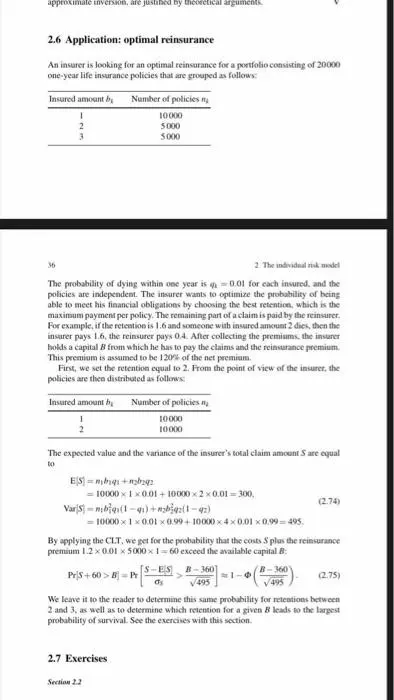
Transcribed Image Text:
approximate inversion, are justified by theoretical arguments.
2.6 Application: optimal reinsurance
An insurer is looking for an optimal reinsurance for a portfolio consisting of 20000
one-year life insurance policies that are grouped as follows:
Insured amount by
Number of policies
10000
2
3
5000
5000
36
2. The individual risk model
The probability of dying within one year is 0.01 for each insured, and the
policies are independent. The insurer wants to optimize the probability of being
able to meet his financial obligations by choosing the best retention, which is the
maximum payment per policy. The remaining part of a claim is paid by the reinsurer.
For example, if the retention is 1.6 and someone with insured amount 2 dies, then the
insurer pays 1.6, the reinsurer pays 0.4. After collecting the premiums, the insurer
holds a capital B from which he has to pay the claims and the reinsurance premium
This premium is assumed to be 120% of the net premium.
First, we set the retention equal to 2. From the point of view of the insurer, the
policies are then distributed as follows:
Insured amount by Number of policies n
1½
10000
10000
The expected value and the variance of the insurer's total claim amount S are equal
to
ES
+2
= 10000 × 1 × 0.01+10000×2×0.01 = 300,
Vars=b(1-4)+2(1-42)
=10000x 1 x 0.01 x 0.99+10000x4x0.01 x 0.99-495.
(2.74)
By applying the CLT, we get for the probability that the costs S plus the reinsurance
premium 1.2x0.01 x 5000 x 1-60 exceed the available capital B
[S-ES
Pris+60>B-Pr
B-360]
√495
(B-360)
495
(2.75)
We leave it to the reader to determine this same probability for retentions between
2 and 3, as well as to determine which retention for a given B leads to the largest
probability of survival. See the exercises with this section.
2.7 Exercises
Section 2.2
check_circle الجواب — حل مفصل خطوة بخطوة
hourglass_top
🔒
الحل الكامل متاح للمشتركين
اشترك في أرشيف الأسئلة لعرض هذا الحل وآلاف الحلول المفصلة خطوة بخطوة من معلمين معتمدين.