تم الحل ✓
categoryاقتصاد عام
schoolبكالوريوس
event_available2026-07-15
السؤال
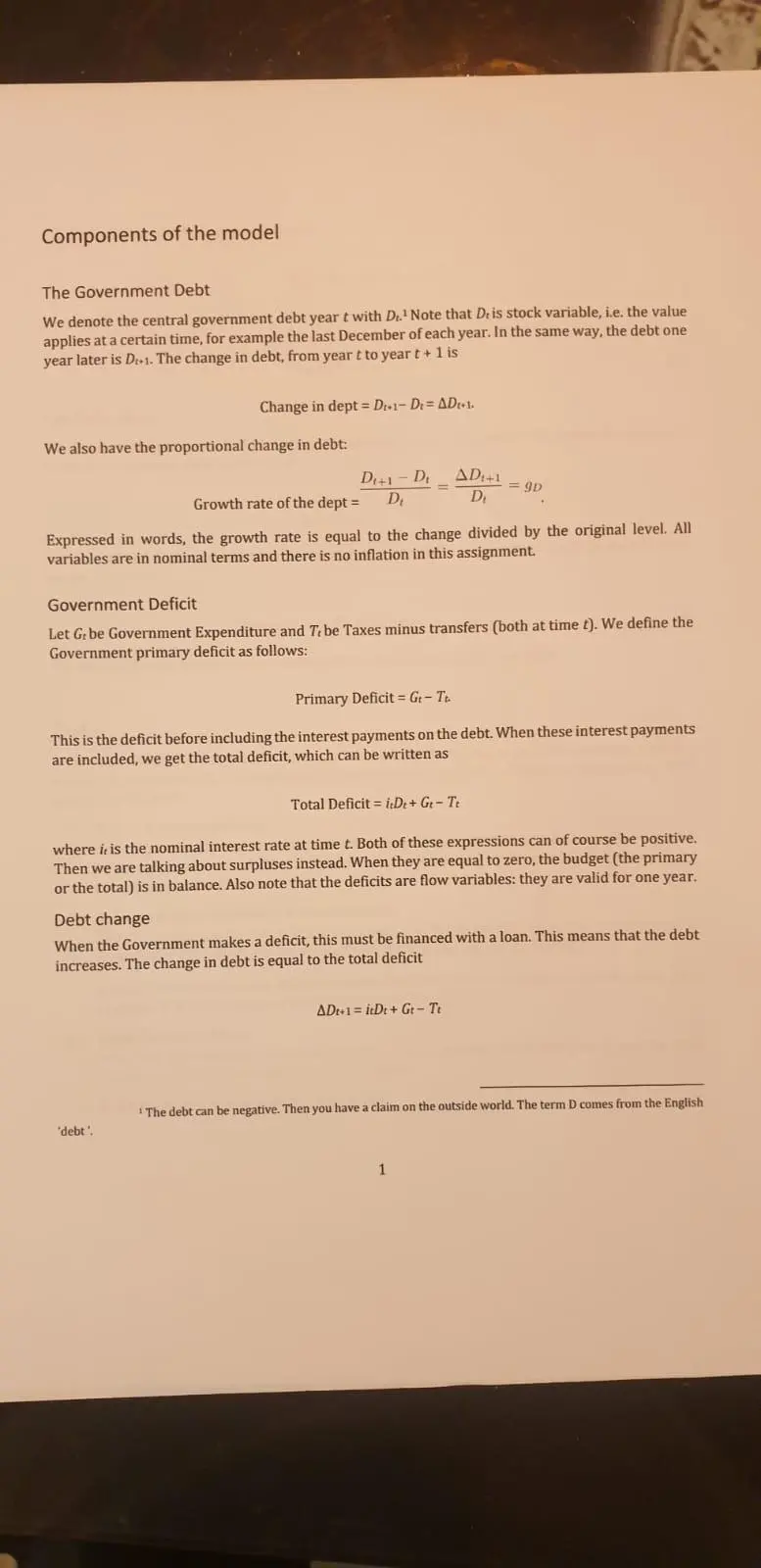
Transcribed Image Text:
Components of the model
The Government Debt
We denote the central government debt year t with Dr. Note that Dr is stock variable, i.e. the value
applies at a certain time, for example the last December of each year. In the same way, the debt one
year later is D-1. The change in debt, from year t to year t + 1 is
Change in dept = Di+1- Dr=AD+1.
We also have the proportional change in debt:
Growth rate of the dept =
D₁+1 - D₁
D₁
ADI+1
D₁
F9D
Expressed in words, the growth rate is equal to the change divided by the original level. All
variables are in nominal terms and there is no inflation in this assignment.
Government Deficit
Let Grbe Government Expenditure and T, be Taxes minus transfers (both at time t). We define the
Government primary deficit as follows:
Primary Deficit Ge- Te
This is the deficit before including the interest payments on the debt. When these interest payments
are included, we get the total deficit, which can be written as
Total Deficit iDe+ Gt-Te
where it is the nominal interest rate at time t. Both of these expressions can of course be positive.
Then we are talking about surpluses instead. When they are equal to zero, the budget (the primary
or the total) is in balance. Also note that the deficits are flow variables: they are valid for one year.
Debt change
When the Government makes a deficit, this must be financed with a loan. This means that the debt
increases. The change in debt is equal to the total deficit
'debt'.
AD+1=itDt+ Gt- Tt
1 The debt can be negative. Then you have a claim on the outside world. The term D comes from the English
1
Since AD+1= D.1- De this can be written as
or
De 1-D itDt+ Gt-Te
De+1 = (1+i)D+ G- Tr
(1)
The Debt Ratio
We denote GDP year t with Y. Assume that the growth rate, gy, is constant. We define the debt ratio
as the ratio between debt and GDP, i.e.
d₁
Debt ratio =
D₁
Y₁
We use the rule for the relationship between proportional changes when starting from a ratio and
we get
Change rate of the debt ratio = ga=go-gy
The debt ratio will thus increase if and only if the debt grows faster than GDP.
(2)
Tasks
When answering the questions below, you can assume that interest rate it is constant, with the
exception of question (f). You may benefit from looking at Chapter 17 of Mankiw, 'Government Debt
and Budget Deficits'.
(a) Primary Budget Balance
How big is the change in debt if the Government manages to keep the primary budget in
balance year after year? What is the growth rate of the debt in this case? Use Equation
(1) to show and explain the result.
(b) Primary budget balance and the debt ratio
Use the expression for the debt's growth rate, which you developed in the previous task, to
simplify the expression for the change rate of the debt ratio in Equation (2).
It can be said that the debt policy is sustainable if the debt ratio does not increase over time,
i.e. if ga≤ 0. What is required for this to be met? Explain!
(c) Total Budget Balance
What will be the change in the debt and the debt's growth rate if the state keeps the total
budget in balance every year? Use (1) to explain.
(d) Total Budget Balance and the Debt Ratio
2
Use the expression you just developed to simplify Equation (2). Is debt policy sustainable in
this case? Explain!
(e) The one-percent target
Until fairly recently, there was a rule for the Government budget process in Sweden which
said that there should be a total budget surplus corresponding to 1% of GDP.2 How does this
rule change Equations (1) and (2)? Explain the consequences of this.
(f) Variable interest rate
Now assume that the interest rate varies with the Debt Ratio, so that
it = io+ax du
where io is a constant. This means that the interest rate rises when the country becomes more
indebted, as the lenders then experience an increased risk that they will not get their money
back.
Assume that the state keeps the primary budget in balance. What is the expression for the
growth rate in D in this case? What will be the expression of the growth rate in the debt ratio?
Interpret the latter equation. To facilitate this interpretation, it may help to note that the
equation for ga has a positive and a negative term on the right. Try to illustrate the two terms
in a figure with d on the horizontal axis. There is an intersection between the curves. Does d
move towards or away from this point? Explain how the debt ratio develops, depending on
where you start.
2 More specifically, the rule was that there would be such a surplus 'over the business cycle. We simplify here by
assuming that the surplus is one percent each year.
3
check_circle الجواب — حل مفصل خطوة بخطوة
hourglass_top
🔒
الحل الكامل متاح للمشتركين
اشترك في أرشيف الأسئلة لعرض هذا الحل وآلاف الحلول المفصلة خطوة بخطوة من معلمين معتمدين.