تم الحل ✓
categoryكيمياء
schoolبكالوريوس
event_available2026-07-13
السؤال
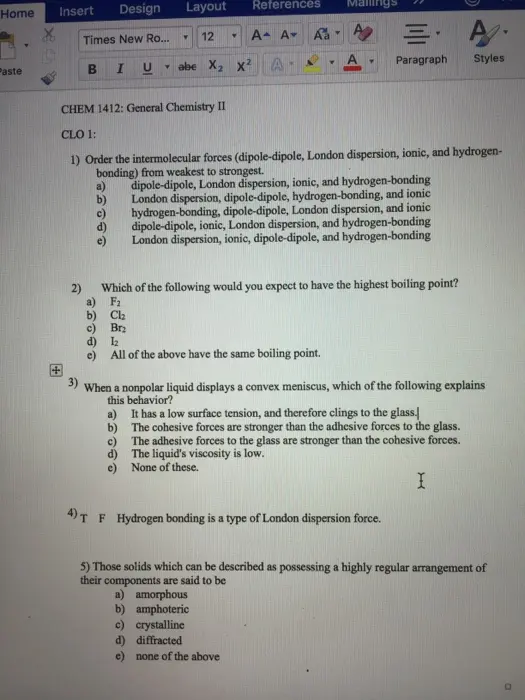
Transcribed Image Text:
Home
Insert Design
Layout
References
Times New Ro...
12
4
A A
A
4
Paste
B
押)
Mallings
二·
A.
A
Paragraph Styles
I U abe X2 X2
CHEM 1412: General Chemistry II
CLO 1:
1) Order the intermolecular forces (dipole-dipole, London dispersion, ionic, and hydrogen-
bonding) from weakest to strongest.
2)
dipole-dipole, London dispersion, ionic, and hydrogen-bonding
London dispersion, dipole-dipole, hydrogen-bonding, and ionic
hydrogen-bonding, dipole-dipole, London dispersion, and ionic
dipole-dipole, ionic, London dispersion, and hydrogen-bonding
London dispersion, ionic, dipole-dipole, and hydrogen-bonding
Which of the following would you expect to have the highest boiling point?
a) F₂
b) Cl₂
+
c)
Br2
3)
d) 12
e)
All of the above have the same boiling point.
When a nonpolar liquid displays a convex meniscus, which of the following explains
this behavior?
a)
It has a low surface tension, and therefore clings to the glass.
b) The cohesive forces are stronger than the adhesive forces to the glass.
The adhesive forces to the glass are stronger than the cohesive forces.
The liquid's viscosity is low.
(၁
d)
None of these.
4)T F Hydrogen bonding is a type of London dispersion force.
I
5) Those solids which can be described as possessing a highly regular arrangement of
their components are said to be
a) amorphous
b) amphoteric
c) crystalline
d) diffracted
none of the above
check_circle الجواب — حل مفصل خطوة بخطوة
hourglass_top
🔒
الحل الكامل متاح للمشتركين
اشترك في أرشيف الأسئلة لعرض هذا الحل وآلاف الحلول المفصلة خطوة بخطوة من معلمين معتمدين.