تم الحل ✓
categoryهندسة كيميائية
schoolبكالوريوس
event_available2026-07-15
السؤال
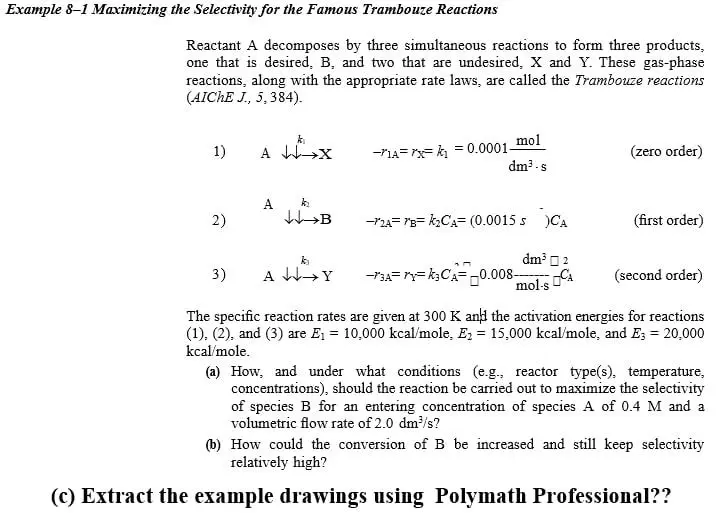
Transcribed Image Text:
Example 8-1 Maximizing the Selectivity for the Famous Trambouze Reactions
Reactant A decomposes by three simultaneous reactions to form three products,
one that is desired, B, and two that are undesired, X and Y. These gas-phase
reactions, along with the appropriate rate laws, are called the Trambouze reactions
(AIChE J., 5,384).
k
1) A W→X
-1A==k₁ = 0.0001-
mol
dm³-s
(zero order)
k₂
2)
WB
-12A=7B= k₂CA= (0.0015s CA
(first order)
3)
A WY
dm³ 2
-13A=7y=k³CA= -0.008-
mol-s CA
(second order)
The specific reaction rates are given at 300 K and the activation energies for reactions
(1), (2), and (3) are E₁ = 10,000 kcal/mole, Ez = 15,000 kcal/mole, and E3 = 20,000
kcal/mole.
(a) How, and under what conditions (e.g., reactor type(s), temperature,
concentrations), should the reaction be carried out to maximize the selectivity
of species B for an entering concentration of species A of 0.4 M and a
volumetric flow rate of 2.0 dm³/s?
(b) How could the conversion of B be increased and still keep selectivity
relatively high?
(c) Extract the example drawings using Polymath Professional??
check_circle الجواب — حل مفصل خطوة بخطوة
hourglass_top
🔒
الحل الكامل متاح للمشتركين
اشترك في أرشيف الأسئلة لعرض هذا الحل وآلاف الحلول المفصلة خطوة بخطوة من معلمين معتمدين.