تم الحل ✓
categoryفيزياء
schoolبكالوريوس
event_available2026-07-15
السؤال
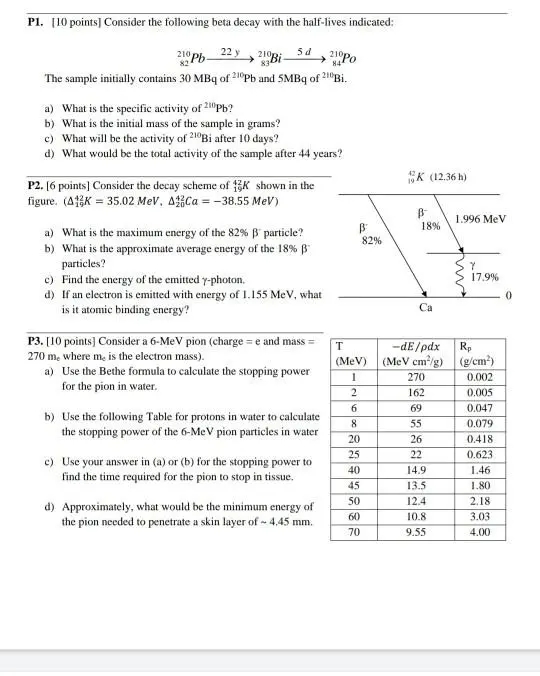
Transcribed Image Text:
P1. [10 points] Consider the following beta decay with the half-lives indicated:
21Po
210Pb-
22 y
210Bi-
3d
83
84
The sample initially contains 30 MBq of 210Pb and 5MBq of 210Bi.
a) What is the specific activity of 2pb?
b) What is the initial mass of the sample in grams?
c) What will be the activity of 210Bi after 10 days?
d) What would be the total activity of the sample after 44 years?
P2. [6 points] Consider the decay scheme of 1K shown in the
figure. (AK=35.02 MeV, ACa=-38.55 MeV)
a) What is the maximum energy of the 82% ẞ particle?
b) What is the approximate average energy of the 18% ẞ
particles?
c) Find the energy of the emitted y-photon.
d) If an electron is emitted with energy of 1.155 MeV, what
is it atomic binding energy?
P3. [10 points] Consider a 6-MeV pion (charge = e and mass=
270 me where me is the electron mass).
K (12.36 h)
B
82%
B-
18%
1.996 MeV.
Ca
Y
17.9%
T
-dE/pdx
Rp
(MeV)
(MeV cm/g)
(g/cm²)
a) Use the Bethe formula to calculate the stopping power
for the pion in water.
1
270
0.002
2
162
0.005
6
69
0.047
b) Use the following Table for protons in water to calculate
the stopping power of the 6-MeV pion particles in water
c) Use your answer in (a) or (b) for the stopping power to
find the time required for the pion to stop in tissue.
d) Approximately, what would be the minimum energy of
the pion needed to penetrate a skin layer of - 4.45 mm.
8
55
0.079
20
26
0.418
25
22
0.623
40
14.9
1.46
45
13.5
1.80
50
12.4
2.18
60
10.8
3.03
70
9.55
4.00
P4. [6 points] A beta ray is incident normally on a 0.35 cm thick lead slab (density = 11.4 g/cm³) lies on
the top of Lucite slab (density = 1.19 g/cm³). The beta rays emerge from the lead slab with energy of
3.69MeV.
The range R (in g/cm²) of the electrons is related to the kinetic energy T (in MeV) by the following:
Lucite: R= 0.334 71.5
Lead:
R = 0.426 T
a) What is the energy of beta rays when it entered the lead slab?
b) What minimum thickness of Lucite (in cm) needed to stop the
beta rays from emerging the slab?
T
Lead
T-3.69MeV
Lucite
0.35 cm
d
P5. [12 points] A parallel beam of 500 keV photons is normally incident on a sheet of lead (density =
11.4 g/cm³). If the rate of energy transmission is 4x10 MeV/s and the fraction of incident photons
absorbed in the sheet is 0.6 and given that p/p = 0.15 cm²/g. Hen/p=0.1 cm²/g. He/p = 0.11 cm²/g
a) What is the thickness of the lead sheet?
b) How many photons per second are incident on the sheet?
c) What fraction of the transmitted energy fluence rate is due to uncollided photons?
d) What fraction of the initial kinetic energy transferred to the electrons is emitted as Bremsstrahlung?
e) Calculate the atomic cross section.
P6. [3 points] Be decays to Li, with half-life of 53.3 days. What is the type of this decay? Why?
(A Be 15.769 MeV, A Li = 14.907 MeV).
P7. [3 points] The maximum energy lost by a charged particle of energy E in a collision with an electron
is given by
4mME
(m+M)
where m is the electron mass (constant) and M is the charged particle mass (variable).
Show that Qmax has its maximum value when M = m.
check_circle الجواب — حل مفصل خطوة بخطوة
hourglass_top
🔒
الحل الكامل متاح للمشتركين
اشترك في أرشيف الأسئلة لعرض هذا الحل وآلاف الحلول المفصلة خطوة بخطوة من معلمين معتمدين.