تم الحل ✓
categoryرياضيات
schoolبكالوريوس
event_available2026-07-15
السؤال
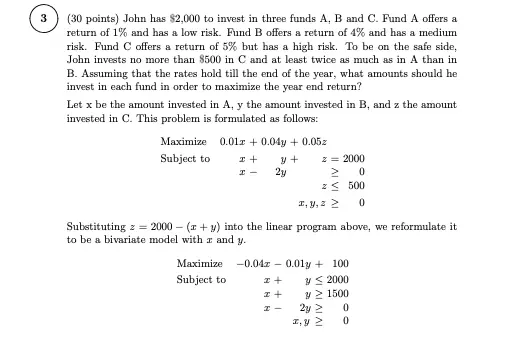
Transcribed Image Text:
3
(30 points) John has $2,000 to invest in three funds A, B and C. Fund A offers a
return of 1% and has a low risk. Fund B offers a return of 4% and has a medium
risk. Fund C offers a return of 5% but has a high risk. To be on the safe side,
John invests no more than $500 in C and at least twice as much as in A than in
B. Assuming that the rates hold till the end of the year, what amounts should he
invest in each fund in order to maximize the year end return?
Let x be the amount invested in A, y the amount invested in B, and z the amount
invested in C. This problem is formulated as follows:
Maximize 0.01x + 0.04y+ 0.05z
Subject to
x+
3+
z=2000
エー
2y
0
<< 500
x, y,
0
Substituting z=2000-(x+y) into the linear program above, we reformulate it
to be a bivariate model with x and y.
Maximize
Subject to
-0.04x-
0.01y+100
x+
y≤2000
x +
y≥ 1500
2y>
0
x, y
0
a: Draw the feasible region of the bivarate linear program.
b: Find an optimal solution of the bivarate linear program, and calulate the
optimal year end return.
c: Write the dual program of the bivarate linear program.
d: Compute an optimal dual solution using the complementary slackness prop-
erty.
e: Complete the following three sentences using the results obtained in Parts
a-d:
If John decides to invest no more than $400 in Fund C, it is estimated that
the optimal year end return that you caculate in Part B (increases/decreases)
by
dollars at (least most).
If Fund A now offers a return of 2%, it is estimated the optimal year end
return (increases/decreases) by
dollars at (least most).
If Fund C now offers a return of 4.5%, it is estimated the optimal year end
return (increases/decreases) by
dollars at (least most).
check_circle الجواب — حل مفصل خطوة بخطوة
hourglass_top
🔒
الحل الكامل متاح للمشتركين
اشترك في أرشيف الأسئلة لعرض هذا الحل وآلاف الحلول المفصلة خطوة بخطوة من معلمين معتمدين.