تم الحل ✓
categoryذكاء اصطناعي وتعلم آلة
schoolبكالوريوس
event_available2026-07-15
السؤال
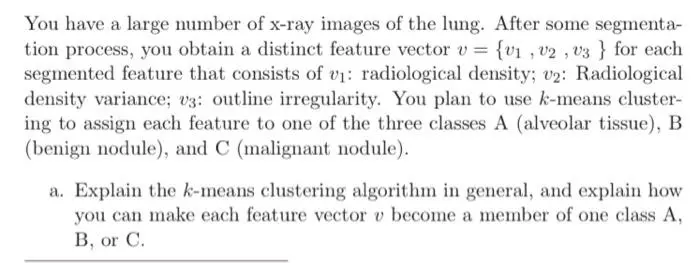
Transcribed Image Text:
You have a large number of x-ray images of the lung. After some segmenta-
tion process, you obtain a distinct feature vector v = {v1, v2, v3 } for each
segmented feature that consists of v₁: radiological density; v2: Radiological
density variance; v3: outline irregularity. You plan to use k-means cluster-
ing to assign each feature to one of the three classes A (alveolar tissue), B
(benign nodule), and C (malignant nodule).
a. Explain the k-means clustering algorithm in general, and explain how
you can make each feature vector v become a member of one class A,
B, or C.
b. Assume that alveolar tissue has a low radiological density, and nod-
ules can be recognized by their higher radiological density. The three
classes can be approximately described through
Alveolar tissue: Low and fairly homogeneous density, wide spread
of irregularity
Benign nodules: High density with high density variance, but low
shape irregularity
• Malignant nodules: High density with high density variance and
high shape irregularity
In the orthogonal space of {v1, v2, v3 } provided in Figure 6, sketch
where you would expect to find most of the members of the three
classes (for example, as three clouds). How does this information help
you select the initial class centroids?
V1A
(density)
(shape irreg.)
V3
(density var.)
v2
check_circle الجواب — حل مفصل خطوة بخطوة
hourglass_top
🔒
الحل الكامل متاح للمشتركين
اشترك في أرشيف الأسئلة لعرض هذا الحل وآلاف الحلول المفصلة خطوة بخطوة من معلمين معتمدين.