تم الحل ✓
categoryالفيزياء
schoolبكالوريوس
event_available2026-07-15
السؤال
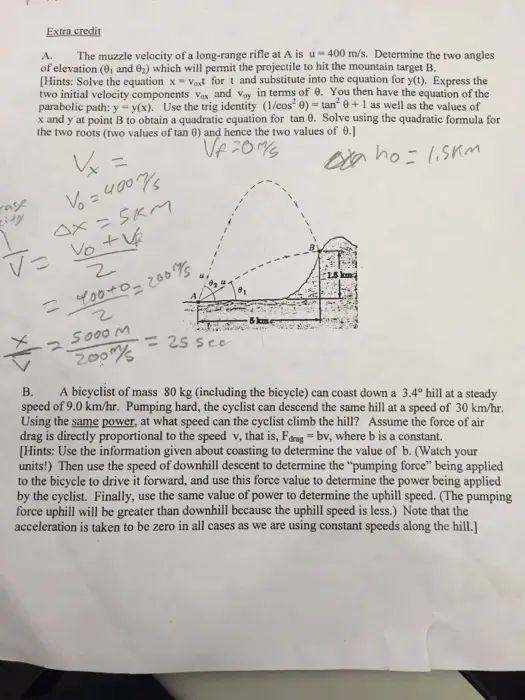
Transcribed Image Text:
rage
B.
Extra credit
A. The muzzle velocity of a long-range rifle at A is u-400 m/s. Determine the two angles
of elevation (0, and 02) which will permit the projectile to hit the mountain target B.
[Hints: Solve the equation x Voxt for t and substitute into the equation for y(t). Express the
two initial velocity components Vox and Voy in terms of 0. You then have the equation of the
parabolic path: y-y(x). Use the trig identity (1/cos2 0) tan2 0+1 as well as the values of
x and y at point B to obtain a quadratic equation for tan 0. Solve using the quadratic formula for
the two roots (two values of tan 0) and hence the two values of 0.]
Vx =
V₁ = 40075
0x=5KM
2
= 400+0200
2
5000 M
200
VAZOMS
=25 see
oa ho= 1.5km
A bicyclist of mass 80 kg (including the bicycle) can coast down a 3.4° hill at a steady
speed of 9.0 km/hr. Pumping hard, the cyclist can descend the same hill at a speed of 30 km/hr.
Using the same power, at what speed can the cyclist climb the hill? Assume the force of air
drag is directly proportional to the speed v, that is, Farag bv, where b is a constant.
[Hints: Use the information given about coasting to determine the value of b. (Watch your
units!) Then use the speed of downhill descent to determine the "pumping force" being applied
to the bicycle to drive it forward, and use this force value to determine the power being applied
by the cyclist. Finally, use the same value of power to determine the uphill speed. (The pumping
force uphill will be greater than downhill because the uphill speed is less.) Note that the
acceleration is taken to be zero in all cases as we are using constant speeds along the hill.]
check_circle الجواب — حل مفصل خطوة بخطوة
hourglass_top
🔒
الحل الكامل متاح للمشتركين
اشترك في أرشيف الأسئلة لعرض هذا الحل وآلاف الحلول المفصلة خطوة بخطوة من معلمين معتمدين.