تم الحل ✓
categoryالفيزياء
schoolبكالوريوس
event_available2026-07-15
السؤال
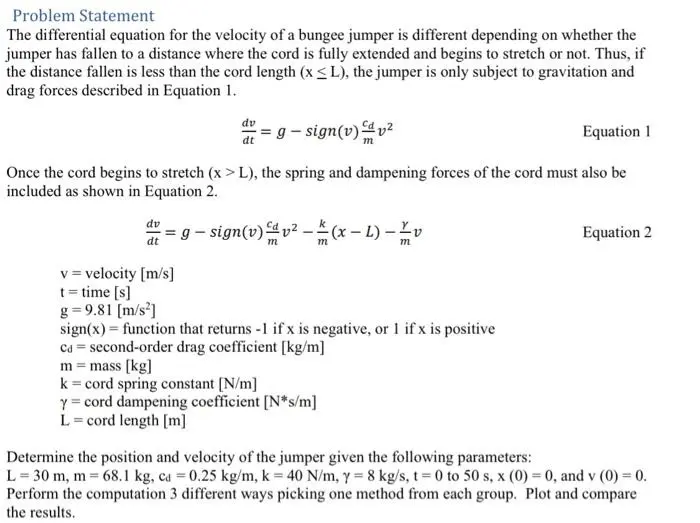
Transcribed Image Text:
Problem Statement
The differential equation for the velocity of a bungee jumper is different depending on whether the
jumper has fallen to a distance where the cord is fully extended and begins to stretch or not. Thus, if
the distance fallen is less than the cord length (XL), the jumper is only subject to gravitation and
drag forces described in Equation 1.
dv
=g-sign(v) v2
m
Equation 1
Once the cord begins to stretch (x > L), the spring and dampening forces of the cord must also be
included as shown in Equation 2.
dv
=g-sign(v) v2(x-L) - v
Equation 2
v = velocity [m/s]
t = time [s]
g=9.81 [m/s²]
sign(x)= function that returns -1 if x is negative, or 1 if x is positive
ca second-order drag coefficient [kg/m]
m = mass [kg]
kcord spring constant [N/m]
y cord dampening coefficient [N*s/m]
L = cord length [m]
Determine the position and velocity of the jumper given the following parameters:
L=30 m, m = 68.1 kg, ca = 0.25 kg/m, k = 40 N/m, y = 8 kg/s, t = 0 to 50 s, x (0) = 0, and v (0) = 0.
Perform the computation 3 different ways picking one method from each group. Plot and compare
the results.
check_circle الجواب — حل مفصل خطوة بخطوة
hourglass_top
🔒
الحل الكامل متاح للمشتركين
اشترك في أرشيف الأسئلة لعرض هذا الحل وآلاف الحلول المفصلة خطوة بخطوة من معلمين معتمدين.