تم الحل ✓
categoryالفيزياء
schoolبكالوريوس
event_available2026-07-15
السؤال
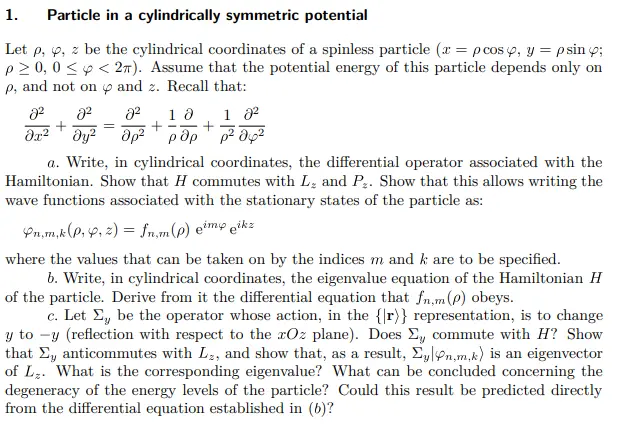
Transcribed Image Text:
1. Particle in a cylindrically symmetric potential
Let p, p, z be the cylindrical coordinates of a spinless particle (x = pcos, y = psin ;
p≥ 0, 0 ≤<2π). Assume that the potential energy of this particle depends only on
p, and not on y and z. Recall that:
a² a²
+
მე2 მყო
82
=
მი2
+
-
1 ə 1 02
+
a. Write, in cylindrical coordinates, the differential operator associated with the
Hamiltonian. Show that H commutes with L, and P. Show that this allows writing the
wave functions associated with the stationary states of the particle as:
On,m,k(P,4,2)=fn,m(p) eim eikz
where the values that can be taken on by the indices m and k are to be specified.
b. Write, in cylindrical coordinates, the eigenvalue equation of the Hamiltonian H
of the particle. Derive from it the differential equation that fn,m(p) obeys.
c. Let Σy be the operator whose action, in the {\r)} representation, is to change
y to -y (reflection with respect to the Oz plane). Does Σ, commute with H? Show
that Σy anticommutes with L₂, and show that, as a result, Σyn,m,k) is an eigenvector
of L. What is the corresponding eigenvalue? What can be concluded concerning the
degeneracy of the energy levels of the particle? Could this result be predicted directly
from the differential equation established in (b)?
check_circle الجواب — حل مفصل خطوة بخطوة
hourglass_top
🔒
الحل الكامل متاح للمشتركين
اشترك في أرشيف الأسئلة لعرض هذا الحل وآلاف الحلول المفصلة خطوة بخطوة من معلمين معتمدين.