تم الحل ✓
categoryالفيزياء
schoolبكالوريوس
event_available2026-07-15
السؤال
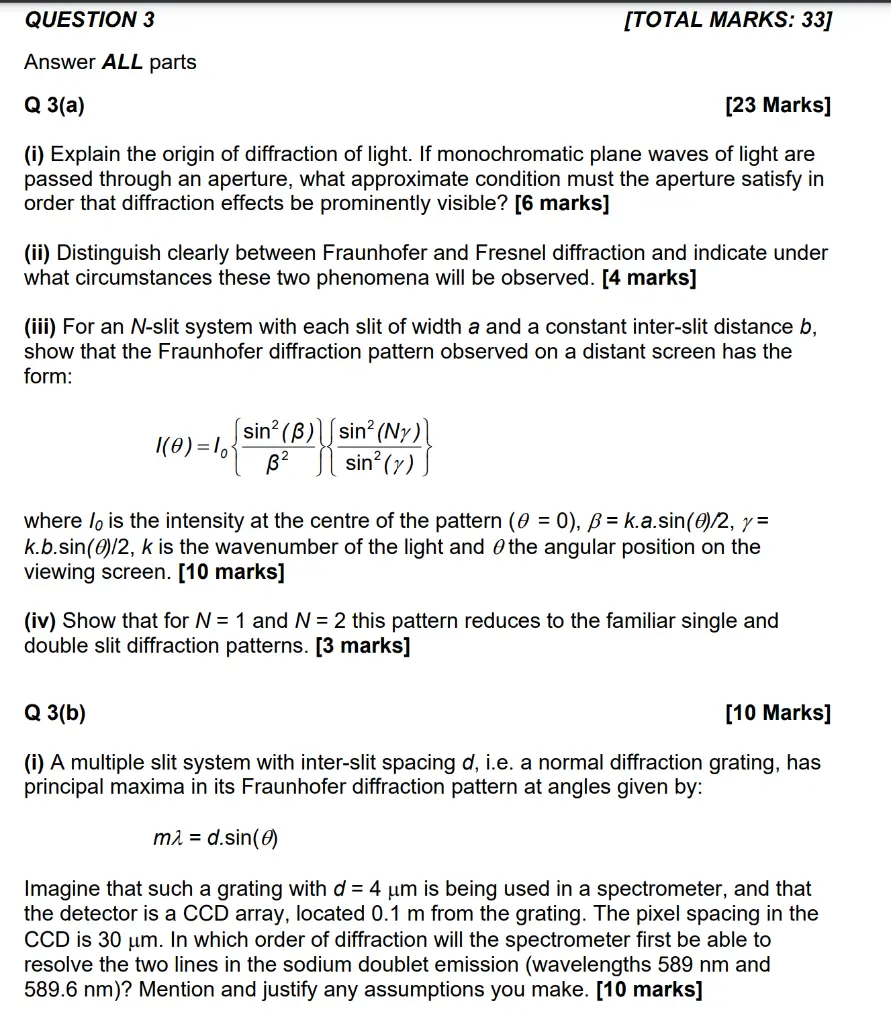
Transcribed Image Text:
QUESTION 3
Answer ALL parts
Q 3(a)
[TOTAL MARKS: 33]
[23 Marks]
(i) Explain the origin of diffraction of light. If monochromatic plane waves of light are
passed through an aperture, what approximate condition must the aperture satisfy in
order that diffraction effects be prominently visible? [6 marks]
(ii) Distinguish clearly between Fraunhofer and Fresnel diffraction and indicate under
what circumstances these two phenomena will be observed. [4 marks]
(iii) For an N-slit system with each slit of width a and a constant inter-slit distance b,
show that the Fraunhofer diffraction pattern observed on a distant screen has the
form:
1(0)=1
(sin² (B) sin² (Ny)\
sin² (y)
where /o is the intensity at the centre of the pattern (0 = 0), B = k.a.sin(e)/2, y =
k.b.sin()/2, k is the wavenumber of the light and the angular position on the
viewing screen. [10 marks]
(iv) Show that for N = 1 and N = 2 this pattern reduces to the familiar single and
double slit diffraction patterns. [3 marks]
Q 3(b)
[10 Marks]
(i) A multiple slit system with inter-slit spacing d, i.e. a normal diffraction grating, has
principal maxima in its Fraunhofer diffraction pattern at angles given by:
mλ = d.sin(e)
Imagine that such a grating with d = 4 μm is being used in a spectrometer, and that
the detector is a CCD array, located 0.1 m from the grating. The pixel spacing in the
CCD is 30 μm. In which order of diffraction will the spectrometer first be able to
resolve the two lines in the sodium doublet emission (wavelengths 589 nm and
589.6 nm)? Mention and justify any assumptions you make. [10 marks]
check_circle الجواب — حل مفصل خطوة بخطوة
hourglass_top
🔒
الحل الكامل متاح للمشتركين
اشترك في أرشيف الأسئلة لعرض هذا الحل وآلاف الحلول المفصلة خطوة بخطوة من معلمين معتمدين.