تم الحل ✓
categoryالفيزياء
schoolبكالوريوس
event_available2026-07-15
السؤال
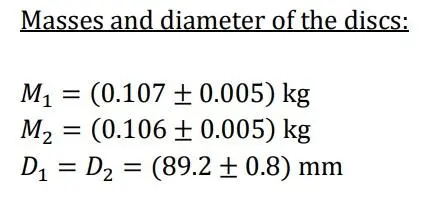
Transcribed Image Text:
Masses and diameter of the discs:
M₁ = (0.107 ± 0.005) kg
=
M2 (0.106 ± 0.005) kg
D₁ = D₂ = (89.2 + 0.8) mm
2
10
Inelastic collision
Linear Fit for: Data Set | Ang. velocity
omega-mt+b
m (Slope) -0.5269 radis/s
b (Y-Intercept): 47.10 radis
Correlation: -0.9983
RMSE: 0.06649 rad/s
Statistics for: Data Set | Ang. velocity
min: 20.81 at 10.89 max: 41.91 at 9.963
572, 19 031 (22 00 by 000
Time (s)
Linear Fit for: Data Set | Ang. velocity
omega mt+b
m (Slope): -0.2070 rad/s/s
b (Y-Intercept): 22.88 radis
Correlation:-0.9744
RMSE 0.1088 rad/s
Question 7 (1 point)
Using the graph for the inelastic collision shown above, calculate the angular
momentum (in kg-m²/s) of the system just before the collision. Use the moment of
inertia that is calculated from the mass and radius of the disc(s) (like you did for Q1).
Round your answer to 5 decimal places.
Your Answer:
Answer
Question 8 (1 point)
Using the graph for the inelastic collision shown above, calculate the absolute value
of the change of rotational kinetic energy (in J) from just before to just after the
collision. Use the moment of inertia that is calculated from the mass and radius of
the disc(s) (like you did in Q1). Round your answer to 4 decimal places.
NB. AK | K-Kil
Your Answer:
Answer
Question 9 (1 point)
Using the graph for the inelastic collision shown above, what is the absolute value of
the rate of decrease of the speed of the system (in rad/s²) after the collision? Round
your answer to the same precision as you see in the graph.
check_circle الجواب — حل مفصل خطوة بخطوة
hourglass_top
🔒
الحل الكامل متاح للمشتركين
اشترك في أرشيف الأسئلة لعرض هذا الحل وآلاف الحلول المفصلة خطوة بخطوة من معلمين معتمدين.