تم الحل ✓
categoryالهندسة الكهربائية
schoolبكالوريوس
event_available2026-07-15
السؤال
Transcribed Image Text:
Question 1 [12 points]
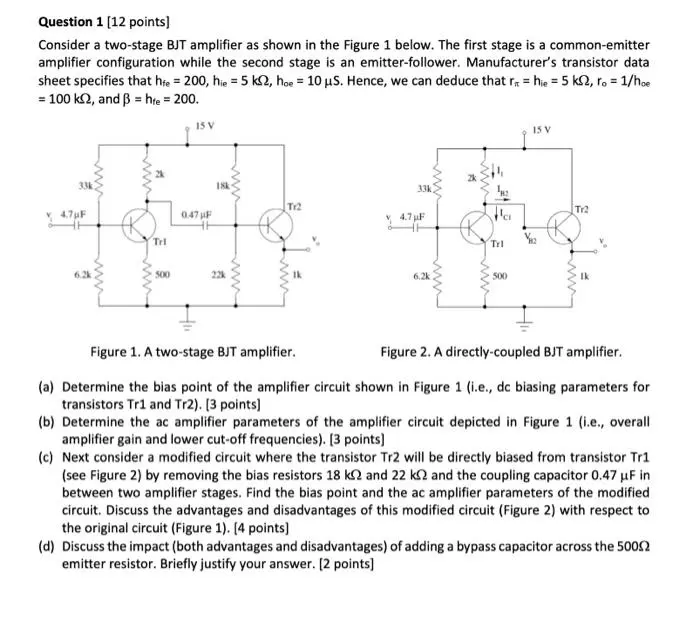
Consider a two-stage BJT amplifier as shown in the Figure 1 below. The first stage is a common-emitter
amplifier configuration while the second stage is an emitter-follower. Manufacturer's transistor data
sheet specifies that hfe = 200, hie = 5 k2, hoe = 10 μS. Hence, we can deduce that r = hie = 5 kn, ro = 1/hoe
= 100 k2, and ẞhre = 200.
=
33k
4.7µF
Tri
15 V
0.47 F
6.2k
500
22k
18k-
www
15 V
33k
T12
4.7 F
Pa
T12
Trl
6.2k
5001
Figure 1. A two-stage BJT amplifier.
Figure 2. A directly-coupled BJT amplifier.
(a) Determine the bias point of the amplifier circuit shown in Figure 1 (i.e., dc biasing parameters for
transistors Tri and Tr2). [3 points]
(b) Determine the ac amplifier parameters of the amplifier circuit depicted in Figure 1 (i.e., overall
amplifier gain and lower cut-off frequencies). [3 points]
(c) Next consider a modified circuit where the transistor Tr2 will be directly biased from transistor Tr1
(see Figure 2) by removing the bias resistors 18 k2 and 22 k2 and the coupling capacitor 0.47 uF in
between two amplifier stages. Find the bias point and the ac amplifier parameters of the modified
circuit. Discuss the advantages and disadvantages of this modified circuit (Figure 2) with respect to
the original circuit (Figure 1). [4 points]
(d) Discuss the impact (both advantages and disadvantages) of adding a bypass capacitor across the 5002
emitter resistor. Briefly justify your answer. [2 points]
check_circle الجواب — حل مفصل خطوة بخطوة
hourglass_top
🔒
الحل الكامل متاح للمشتركين
اشترك في أرشيف الأسئلة لعرض هذا الحل وآلاف الحلول المفصلة خطوة بخطوة من معلمين معتمدين.