تم الحل ✓
categoryهندسة صناعية وإنتاج
schoolبكالوريوس
event_available2026-07-15
السؤال
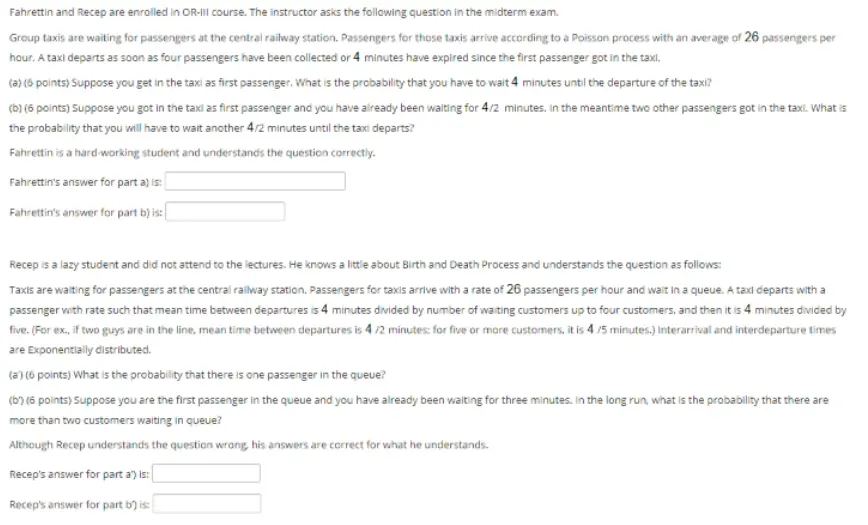
Transcribed Image Text:
Fahrettin and Recep are enrolled in OR-III course. The instructor asks the following question in the midterm exam.
Group taxis are waiting for passengers at the central railway station. Passengers for those taxis arrive according to a Poisson process with an average of 26 passengers per
hour. A taxi departs as soon as four passengers have been collected or 4 minutes have expired since the first passenger got in the taxi.
(a) (6 points) Suppose you get in the taxi as first passenger. What is the probability that you have to wait 4 minutes until the departure of the taxi?
(b) (6 points) Suppose you got in the taxi as first passenger and you have already been waiting for 4/2 minutes. In the meantime two other passengers got in the taxi. What is
the probability that you will have to wait another 4/2 minutes until the taxi departs?
Fahrettin is a hard-working student and understands the question correctly.
Fahrettin's answer for part a) is:
Fahrettin's answer for part b) is:
Recep is a lazy student and did not attend to the lectures. He knows a little about Birth and Death Process and understands the question as follows:
Taxis are waiting for passengers at the central railway station. Passengers for taxis arrive with a rate of 26 passengers per hour and wait in a queue. A taxi departs with a
passenger with rate such that mean time between departures is 4 minutes divided by number of waiting customers up to four customers, and then it is 4 minutes divided by
five. (For ex., if two guys are in the line, mean time between departures is 4/2 minutes: for five or more customers, it is 4/5 minutes.) Interarrival and interdeparture times
are Exponentially distributed.
(a) (6 points) What is the probability that there is one passenger in the queue?
(b) (6 points) Suppose you are the first passenger in the queue and you have already been waiting for three minutes. In the long run, what is the probability that there are
more than two customers waiting in queue?
Although Recep understands the question wrong, his answers are correct for what he understands.
Recep's answer for part a) is:
Recep's answer for part b) is:
check_circle الجواب — حل مفصل خطوة بخطوة
hourglass_top
🔒
الحل الكامل متاح للمشتركين
اشترك في أرشيف الأسئلة لعرض هذا الحل وآلاف الحلول المفصلة خطوة بخطوة من معلمين معتمدين.