تم الحل ✓
categoryهندسة الحاسبات
schoolبكالوريوس
event_available2026-07-15
السؤال
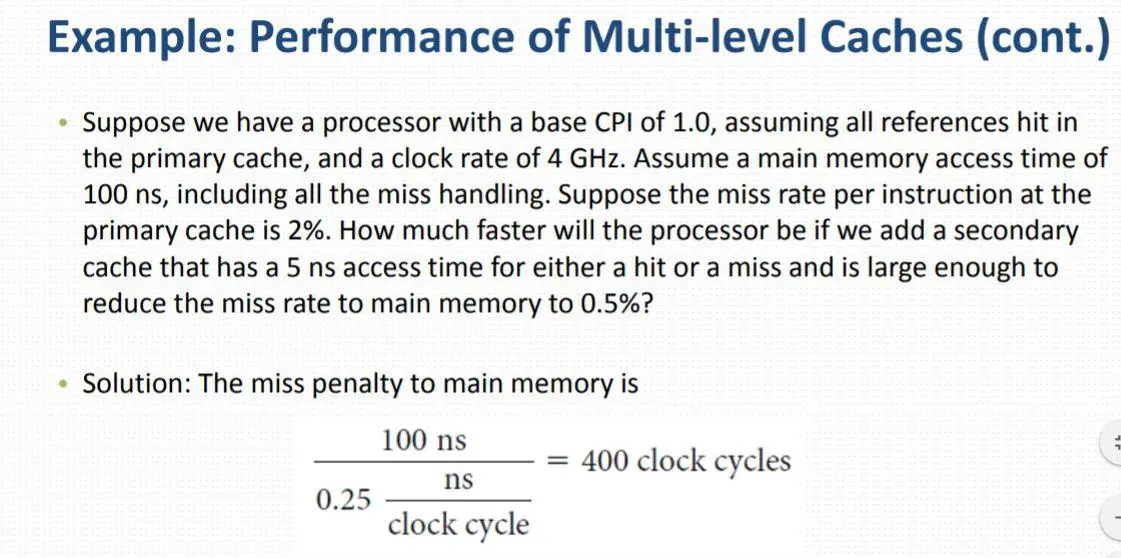
Transcribed Image Text:
Example: Performance of Multi-level Caches (cont.)
Suppose we have a processor with a base CPI of 1.0, assuming all references hit in
the primary cache, and a clock rate of 4 GHz. Assume a main memory access time of
100 ns, including all the miss handling. Suppose the miss rate per instruction at the
primary cache is 2%. How much faster will the processor be if we add a secondary
cache that has a 5 ns access time for either a hit or a miss and is large enough to
reduce the miss rate to main memory to 0.5%?
Solution: The miss penalty to main memory is
0.25
100 ns
ns
clock cycle
= 400 clock cycles
Example: Performance of Multi-level Caches (cont.)
Suppose we have a processor with a base CPI of 1.0, assuming all references hit in
the primary cache, and a clock rate of 4 GHz. Assume a main memory access time of
100 ns, including all the miss handling. Suppose the miss rate per instruction at the
primary cache is 2%. How much faster will the processor be if we add a secondary
cache that has a 5 ns access time for either a hit or a miss and is large enough to
reduce the miss rate to main memory to 0.5%?
Solution: The miss penalty to main memory is
0.25
100 ns
ns
clock cycle
= 400 clock cycles
Example: Performance of Multi-level Caches (cont.)
•
•
Thus, for a two-level cache, total CPI is the sum of the stall cycles from
both levels of cache and the base CPI:
Total CPI = 1 +Primary stalls per instruction + Secondary stalls per
instruction
=1+2% x 20 +0.5% x 400 = 1 + 0.4 + 2.0 = 3.4
•
Thus, the processor with the secondary cache is faster by 9.0/3.4= 2.6
check_circle الجواب — حل مفصل خطوة بخطوة
hourglass_top
🔒
الحل الكامل متاح للمشتركين
اشترك في أرشيف الأسئلة لعرض هذا الحل وآلاف الحلول المفصلة خطوة بخطوة من معلمين معتمدين.