تم الحل ✓
categoryالكيمياء
schoolبكالوريوس
event_available2026-07-15
السؤال
Transcribed Image Text:
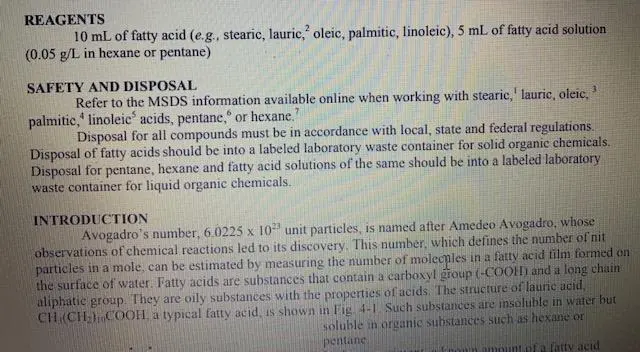
REAGENTS
10 mL of fatty acid (e.g., stearic, lauric, oleic, palmitic, linoleic), 5 mL of fatty acid solution
(0.05 g/L in hexane or pentane)
SAFETY AND DISPOSAL
Refer to the MSDS information available online when working with stearic,' lauric, oleic,
palmitic, linoleic acids, pentane," or hexane."
3
Disposal for all compounds must be in accordance with local, state and federal regulations.
Disposal of fatty acids should be into a labeled laboratory waste container for solid organic chemicals.
Disposal for pentane, hexane and fatty acid solutions of the same should be into a labeled laboratory
waste container for liquid organic chemicals.
INTRODUCTION
Avogadro's number, 6.0225 x 10 unit particles, is named after Amedeo Avogadro, whose
observations of chemical reactions led to its discovery. This number, which defines the number of nit
particles in a mole, can be estimated by measuring the number of molecples in a fatty acid film formed on
the surface of water. Fatty acids are substances that contain a carboxyl group (-COOH) and a long chain
aliphatic group. They are oily substances with the properties of acids. The structure of lauric acid,
CH (CH) COOH, a typical fatty acid, is shown in Fig. 4-1. Such substances are insoluble in water but
soluble in organic substances such as hexane or
pentane
amount of a fatty acid
INTRODUCTION
Avogadro's number, 6.0225 x 10²³ unit particles, is named after Amedeo Avogadro, whose
observations of chemical reactions led to its discovery. This number, which defines the number of nit
particles in a mole, can be estimated by measuring the number of molecules in a fatty acid film formed on
the surface of water. Fatty acids are substances that contain a carboxyl group (-COOH) and a long chain
aliphatic group. They are oily substances with the properties of acids. The structure of lauric acid,
CH3(CH2)10COOH, a typical fatty acid, is shown in Fig. 4-1. Such substances are insoluble in water but
soluble in organic substances such as hexane or
Structural formula
Fig. 4-1 Lauric Acid
Schematic representati
pentane.
In this experiment, a known amount of a fatty acid
solution is deposited on a water surface of known area
(a watch glass can be used to hold the water). As the
solvent evaporates, the fatty acid spreads into a film
whose structure is shown in Fig. 4-2. The acid end of
the fatty acid molecule adheres to the water surface, and
the aliphatic chain stands perpendicular to the surface.
The film formed by such fatty acids is assumed to be
one molecule thick and therefore is called a molecular monolayer. The
boundary of the water surface, and therefore is called a molecular
monolayer. The boundary of the water surface, and therefore the boundary
Experiment 4 Monolayer betermination of Avogadro's Number
Fig. 4-2. Compact fatty acid
molecular monolayer
of the monolayer, will be
defined by the rim of the watch
Fatty acid monolayer glass. Thus, both the mass and
Water surface
Watch glass
the area of the film are measured
in its formation.
If both the volume of the
fatty acid added to the water
surface and the area occupied by the film are known, the film thickness
can be determined. It should closely approximate the length of a fatty
molecule. If one dimension of a fatty acid molecule is known, and if the
molecules have a known shape, it is possible to estimate the volume occupied by a single molecule and
thus to calculate the number of molecules in the film. From the known mass of the film, the number of
molecules per gram can be calculated. Knowledge of the formula weight and the number of molecules per
gram allows calculation of the number of molecules per mole - Avogadro's number.
gram allows calculation of the number of molecules per mole - Avogadro's number.
PROCEDURE
Wear your safety goggles throughout the experiment. Keep fatty acid solutions away from al open
flames. All equipment must be scrupulously clean and rinsed free of any detergent. Record the name and
molecular weight of the assigned fatty acid on your report sheet.
Density Determination
If the assigned fatty acid is a liquid. Determine its density in the following manner. Weigh a dry
10.0-mL graduated cylinder and record its mass. Add 5 to 10 mL of the fatty acid, reweigh, record the
volume of the fatty acid present, and calculate its density in grams per milliliter. Dispose of the fatty acid
in the waste jar designated for that purpose.
If the assigned fatty acid is a solid. Determine its density as follows. Mount a 250-mL beaker on a
wire mesh on a ring stand above a Bunsen burner, Fill the beaker with approximately 200 mL of water
and heat the water to about 85°C. While the water is heating, weigh a dry 10.0-mL graduated cylinder and
record its mass. Add solid fatty acid to the graduated cylinder to a height of 3 to 4 cm, reweigh, and
record the mass of the graduated cylinder and its contents. After the water in the beaker has reached a
temperature of 85°C, stop heating and place the graduated cylinder inside the beaker of water. Do not let
the inside of the cylinder or its contents get wet. The fatty acid should begin to melt within the cylinder.
When all the fatty acid has melted, remove the cylinder from the water bath and dry the outside with a
towel. Allow the liquid to condense once more into a solid. Record the column of fatty acid present and
calculate the density in grams per mL. Dispose of the fatty acid as directed by your instructor.
Dropper calibration
Prepare a capillary dropping pipet from a piece of 7-mm glass tubing. The capillary should be at
least 5 cm long and the wide portion at least 10 cm long. (Review the material on glass working in the
Laboratory Equipment and Techniques section.) After it has cooled, fit it with a rubber dropper bulb.
From your instructor obtain, in a covered beaker, 5 mL of a
solution of the same fatty acid. The solution should contain an
accurately known concentration of fatty acid in an easily vaporized
solvent (e.g., hexane). Record the concentration of fatty acid in g/mL
of solution. Calibrate the pipet by counting and recording the
number of drops of fatty acid solution required to fill a 10-mL
graduated cylinder to the 2-mL mark.
Properties of the Film
Measure and record the diameter of a "100-mm" watch
glass to the nearest 0.2 mm in several directions. Calculate an
Experiment 4 Monolayer Determination of Avogadro's Number
Fig. 4-3. Watch glass mounted on
ring stand
average diameter. Place the 100-mm watch glass on a 3-in iron ring mounted on a ring stand and then fill
it to the grim with distilled water as shown in Fig. 4-3. A truly clean watch glass will show no "dimples"
about the glass-water interface. Equipment must be scrupulously clean.
Using the calibrated pipet, slowly and gently add drops of fatty acid solution to the water surface
at the center of the watch glass Be sure to record the number of drops of solution added to the surface of
the water. As the solvent evaporates, a thin film of fatty acid will be deposited on the surface of the water.
Allow about 10 seconds per drop for the solvent to evaporate. Continue to add the fatty acid solution until
it is no longer dispersed across the water surface, that is, until the addition of a single drop forms a lens of
fatty acid. Under these conditions the surface of the water is covered by a monolayer of fatty acid.
Dispose of the excess fatty acid solution as directed by your instructor.
Calculations. From the volume and known concentration of fatty acid solution added, calculate
the mass of fatty acid present as a thin film.
Mass of
fatty acid
=
drops of
fatty acid
milliliters of
grams of fatty acid
X
film
solution added.
fatty acid solution
per drop
x
per milliliter
of solution
Calculate the average thickness of the thin film using the previously determined density and
mass.
Volume of fatty acid film =
mass of fatty acid monolayer film
density of fatty acid
Calculate the average thickness of the thin film from its volume and area.
Average film thickness=
volume of fatty acid
surface area of monolayer film
If the assumption that a molecular monolayer of fatty acid is formed is correct, then the average
film thickness should equal the apparent length of a fatty acid molecule.
Perform the following calculations to the correct number of significant digits, Use a separate
sheet and include it in the report on this experiment. Show all units used in arriving at an answer. Record
the answers in the appropriate spaces on the report sheet
As a rough approximation, consider that the fatty acid film is a molecular monolayer and the
molecules are cubes. What is the length, I, of an edge? The volume of a cube is given by the formula
1=1
Determine the volume of one molecule. Since the volume of the film is known, the number of
molecules in the film can be calculated.
Number of molecules in film = volume of fatty acid film
volume of one molecule
Divide the number of molecules in the film by the mass of the monolayer to find the number of
molecules per gram of fatty acid. Avogadro's number (No, the number of molecules in 1 mole) can be
calculated from the number of molecules per gram and the molecular weight.
No number of molecules per gram x mass per mole
= number of molecules per gram x molecular weight
= number of molecules per mole
DATA AND RESULTS
REPORT ON EXPERIMENT 4
Monolayer Determination of Avogadro's Number
Assigned fatty acid Stearic Acid_
-
Molecular weight 284.48 g/mol
Density Determination (Volume Acid = 10 mL)
Mass of graduated cylinder and fatty acid
37.48 g
29.57
Mass of dry graduated cylinder
g
Mass of fatty acid
Density of fatty acid
Dropper Calibration
Number of drops per milliliter
Fatty acid solution concentration
Properties of the Film
Diameter of watch glass
9.25cm
-
84
0.00028 g/L
Number of drops per milliliter
Fatty acid solution concentration
Properties of the Film
Diameter of watch glass
9.25cm
Average diameter, d
Area of monolayer film, d²/4
84
0.00028 g/L
9.17cm
Number of drops of solution required to make film
5 drops
Calculations
Mass of film
Volume of film
Average thickness of film
Dimensions of one molecule ==
Volume of one molecule
Number of molecules in film
Molecules per gram of fatty acid
Avogadro's Number
Show the details of all calculations; use extra sheets if necessary.
QUESTIONS
1.
(Submit your answers on a separate sheet if necessary)
Briefly discuss whether the following "mistakes" would increase, decrease, or have no effect on
the value calculated for Avogadro's number.
a) The solvent does not completely evaporate from the molecular film.
b) The water surface is contaminated by small amounts of detergent.
c) The density of the fatty acid was smaller than reported.
d) The actual number of drops per milliliter of the pipet is small than reported.
2.
An oil tanker whose cargo hold is in the shape of a rectangular solid discharges its oil into a
suitable tank on shore. If the inner dimensions of the tank are 25' x 75' x 25', and a
monomolecular film of oil cannot be removed from the inner wall surfaces, how many gallons of
oil remain? Assume a 2.0 nm thick monolayer of oil is formed.
check_circle الجواب — حل مفصل خطوة بخطوة
hourglass_top
🔒
الحل الكامل متاح للمشتركين
اشترك في أرشيف الأسئلة لعرض هذا الحل وآلاف الحلول المفصلة خطوة بخطوة من معلمين معتمدين.