تم الحل ✓
categoryالرياضيات
schoolبكالوريوس
event_available2026-07-15
السؤال
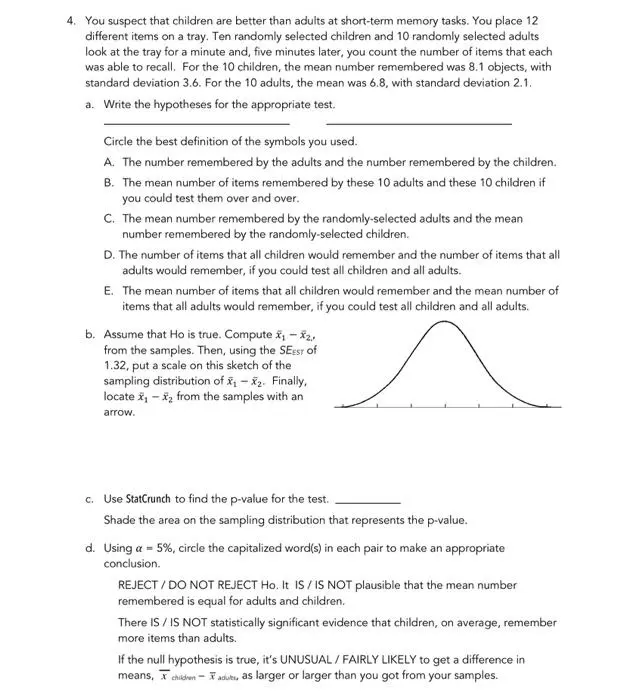
Transcribed Image Text:
4. You suspect that children are better than adults at short-term memory tasks. You place 12
different items on a tray. Ten randomly selected children and 10 randomly selected adults
look at the tray for a minute and, five minutes later, you count the number of items that each
was able to recall. For the 10 children, the mean number remembered was 8.1 objects, with
standard deviation 3.6. For the 10 adults, the mean was 6.8, with standard deviation 2.1.
a. Write the hypotheses for the appropriate test.
Circle the best definition of the symbols you used.
A. The number remembered by the adults and the number remembered by the children.
B. The mean number of items remembered by these 10 adults and these 10 children if
you could test them over and over.
C. The mean number remembered by the randomly-selected adults and the mean
number remembered by the randomly-selected children.
D. The number of items that all children would remember and the number of items that all
adults would remember, if you could test all children and all adults.
E. The mean number of items that all children would remember and the mean number of
items that all adults would remember, if you could test all children and all adults.
b. Assume that Ho is true. Compute x₁ - *₂,
from the samples. Then, using the SEEST of
1.32, put a scale on this sketch of the
sampling distribution of 1-2. Finally,
locate - from the samples with an
arrow.
c. Use StatCrunch to find the p-value for the test.
Shade the area on the sampling distribution that represents the p-value.
d. Using a = 5%, circle the capitalized word(s) in each pair to make an appropriate
conclusion.
REJECT / DO NOT REJECT Ho. It IS/IS NOT plausible that the mean number
remembered is equal for adults and children.
There IS / IS NOT statistically significant evidence that children, on average, remember
more items than adults.
If the null hypothesis is true, it's UNUSUAL / FAIRLY LIKELY to get a difference in
means, children-adu, as larger or larger than you got from your samples.
check_circle الجواب — حل مفصل خطوة بخطوة
hourglass_top
🔒
الحل الكامل متاح للمشتركين
اشترك في أرشيف الأسئلة لعرض هذا الحل وآلاف الحلول المفصلة خطوة بخطوة من معلمين معتمدين.