تم الحل ✓
categoryالرياضيات
schoolبكالوريوس
event_available2026-07-15
السؤال
Transcribed Image Text:
c) + R(x)y(x) = G(x),
(1)
led a second-order linear differential equa-
and G are continuous throughout some open
e equation is said to be homogeneous; other-
-e, the form of a second-order linear homoge-
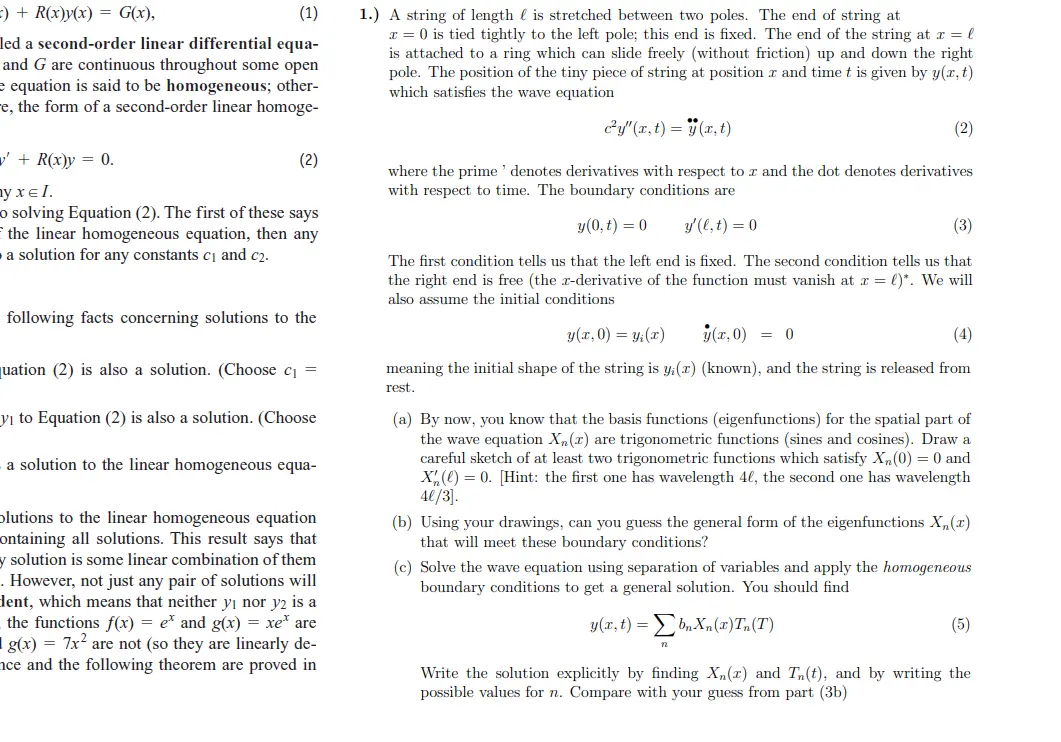
1.) A string of length is stretched between two poles. The end of string at
x = 0 is tied tightly to the left pole; this end is fixed. The end of the string at x = l
is attached to a ring which can slide freely (without friction) up and down the right
pole. The position of the tiny piece of string at position r and time t is given by y(x,t)
which satisfies the wave equation
"(x,t) = (x,t)
(2)
' + R(x)y = 0.
y x = 1.
(2)
o solving Equation (2). The first of these says
the linear homogeneous equation, then any
a solution for any constants c₁ and c2.
following facts concerning solutions to the
quation (2) is also a solution. (Choose c₁ =
yi to Equation (2) is also a solution. (Choose
a solution to the linear homogeneous equa-
Olutions to the linear homogeneous equation
ontaining all solutions. This result says that
y solution is some linear combination of them
. However, not just any pair of solutions will
Hent, which means that neither y₁ nor y2 is a
the functions f(x) = e* and g(x) = xe* are
g(x) = 7x2 are not (so they are linearly de-
nce and the following theorem are proved in
where the prime' denotes derivatives with respect to z and the dot denotes derivatives
with respect to time. The boundary conditions are
y(0,t) = 0 y' (l,t) = 0
(3)
The first condition tells us that the left end is fixed. The second condition tells us that
the right end is free (the z-derivative of the function must vanish at x = ()*. We will
also assume the initial conditions
y(x, 0) = y; (x)
(2.0)
== 0
(4)
meaning the initial shape of the string is y(x) (known), and the string is released from
rest.
(a) By now, you know that the basis functions (eigenfunctions) for the spatial part of
the wave equation X,(x) are trigonometric functions (sines and cosines). Draw a
careful sketch of at least two trigonometric functions which satisfy X,(0) = 0 and
X() = 0. [Hint: the first one has wavelength 4l, the second one has wavelength
41/3].
(b) Using your drawings, can you guess the general form of the eigenfunctions X,(x)
that will meet these boundary conditions?
(c) Solve the wave equation using separation of variables and apply the homogeneous
boundary conditions to get a general solution. You should find
y(x,t) =bnXn(x)T,(T)
n
(5)
Write the solution explicitly by finding X,(z) and Tn(t), and by writing the
possible values for n. Compare with your guess from part (3b)
check_circle الجواب — حل مفصل خطوة بخطوة
hourglass_top
🔒
الحل الكامل متاح للمشتركين
اشترك في أرشيف الأسئلة لعرض هذا الحل وآلاف الحلول المفصلة خطوة بخطوة من معلمين معتمدين.