تم الحل ✓
categoryرياضيات
schoolبكالوريوس
event_available2026-07-15
السؤال
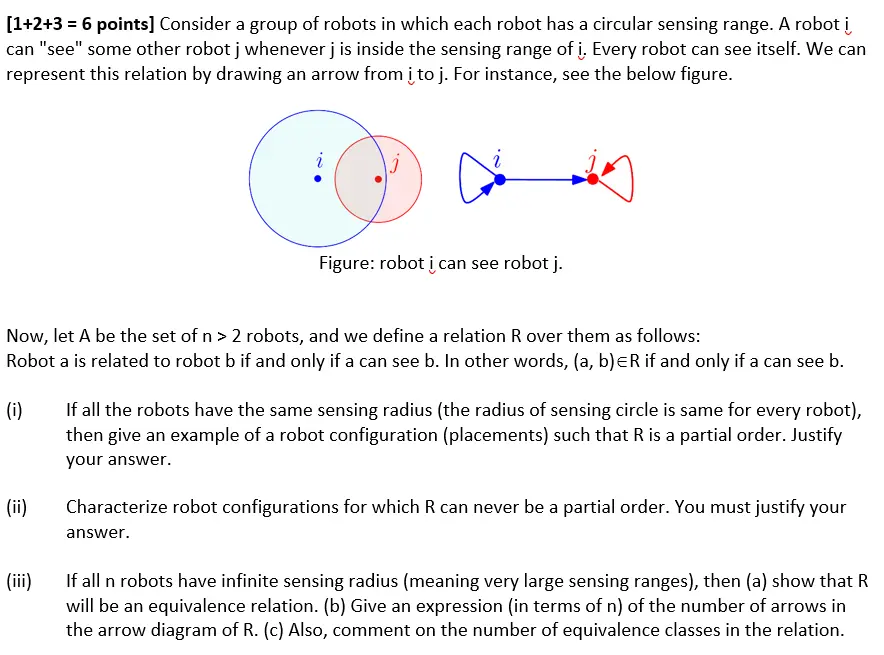
Transcribed Image Text:
[1+2+3 = 6 points] Consider a group of robots in which each robot has a circular sensing range. A robot į
can "see" some other robot j whenever j is inside the sensing range of i. Every robot can see itself. We can
represent this relation by drawing an arrow from i to j. For instance, see the below figure.
Figure: robot i can see robot j.
Now, let A be the set of n > 2 robots, and we define a relation R over them as follows:
Robot a is related to robot b if and only if a can see b. In other words, (a, b) ER if and only if a can see b.
(i)
(ii)
(iii)
If all the robots have the same sensing radius (the radius of sensing circle is same for every robot),
then give an example of a robot configuration (placements) such that R is a partial order. Justify
your answer.
Characterize robot configurations for which R can never be a partial order. You must justify your
answer.
If all n robots have infinite sensing radius (meaning very large sensing ranges), then (a) show that R
will be an equivalence relation. (b) Give an expression (in terms of n) of the number of arrows in
the arrow diagram of R. (c) Also, comment on the number of equivalence classes in the relation.
check_circle الجواب — حل مفصل خطوة بخطوة
hourglass_top
🔒
الحل الكامل متاح للمشتركين
اشترك في أرشيف الأسئلة لعرض هذا الحل وآلاف الحلول المفصلة خطوة بخطوة من معلمين معتمدين.