تم الحل ✓
categoryالفيزياء
schoolبكالوريوس
event_available2026-07-15
السؤال
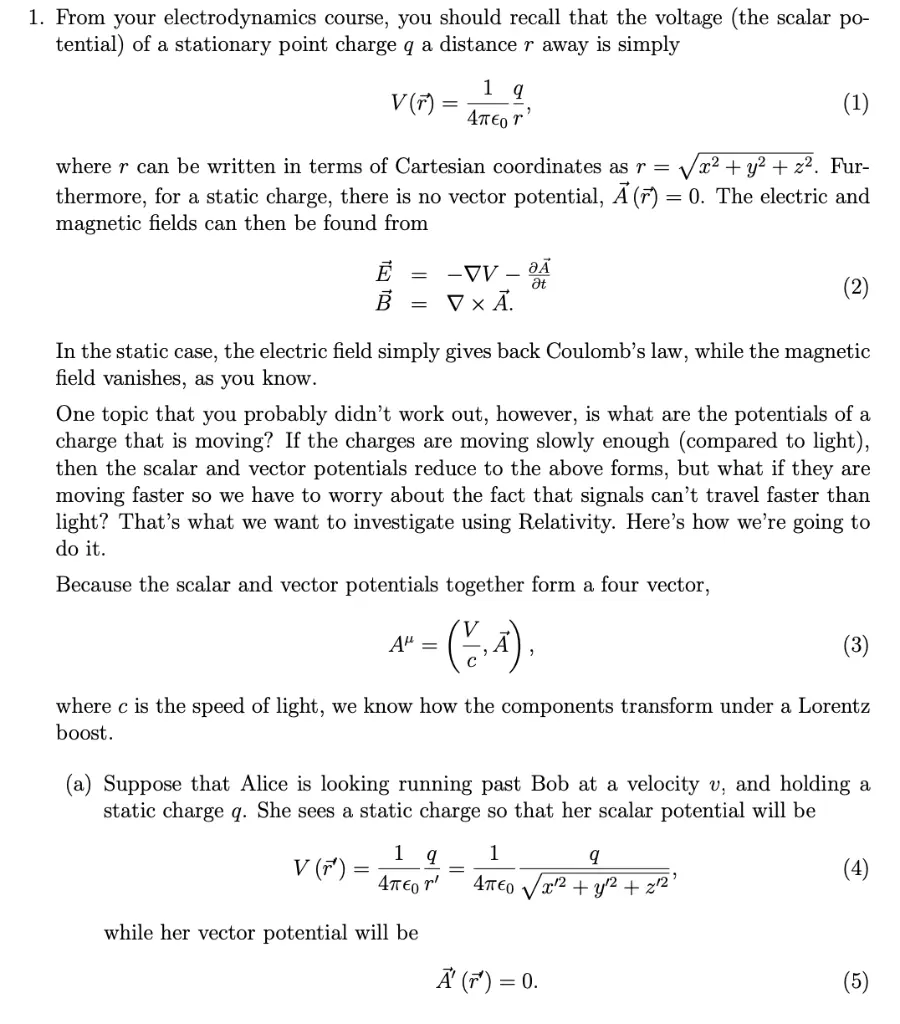
Transcribed Image Text:
1. From your electrodynamics course, you should recall that the voltage (the scalar po-
tential) of a stationary point charge q a distance r away is simply
V(r)
1 q
4περτ
(1)
where can be written in terms of Cartesian coordinates as r = √√x² + y² + z². Fur-
thermore, for a static charge, there is no vector potential, A (r) = 0. The electric and
magnetic fields can then be found from
Ē
=
B
=
-VV - A
V × A.
Ət
(2)
In the static case, the electric field simply gives back Coulomb's law, while the magnetic
field vanishes, as you know.
One topic that you probably didn't work out, however, is what are the potentials of a
charge that is moving? If the charges are moving slowly enough (compared to light),
then the scalar and vector potentials reduce to the above forms, but what if they are
moving faster so we have to worry about the fact that signals can't travel faster than
light? That's what we want to investigate using Relativity. Here's how we're going to
do it.
Because the scalar and vector potentials together form a four vector,
Aμ =
- (ˇ,A),
(3)
where c is the speed of light, we know how the components transform under a Lorentz
boost.
(a) Suppose that Alice is looking running past Bob at a velocity v, and holding a
static charge q. She sees a static charge so that her scalar potential will be
V (r) =
=
1 q
4πЄor'
while her vector potential will be
1
=
A' (r) = 0.
զ
(4)
(5)
Using the fact that the scalar and vector potentials transform as a four-vector,
show that Bob will see a scalar potential
1
γα
(6)
where =
potential
V (r) =
Απερ
√72 (2
√ √² (x − vt)² + y² + z²
1/√1 v2/c². In addition, show that Bob will also see a vector
v
A (r)
=
V (r)
c2
(7)
where is the velocity in the x-direcdtion, and with the scalar potential given in
Eq. (6).
(b) Show that, for the velocity in the x-direction, Eq. (6) can be written
q
1
V (r)
Απεργ (1 v.)
-
(8)
Hint: Note that the time, t, showing up in Eq. (6) is the time it takes for the
information about the potential to reach a distance r, so t = r/c. Then, write
down the vector potential using Eqs. (7) and (8). These potentials are called the
Liénard-Wiechert Potentials, and turn out to be true for a charge moving in any
way.
check_circle الجواب — حل مفصل خطوة بخطوة
hourglass_top
🔒
الحل الكامل متاح للمشتركين
اشترك في أرشيف الأسئلة لعرض هذا الحل وآلاف الحلول المفصلة خطوة بخطوة من معلمين معتمدين.