تم الحل ✓
categoryالفيزياء
schoolبكالوريوس
event_available2026-07-15
السؤال
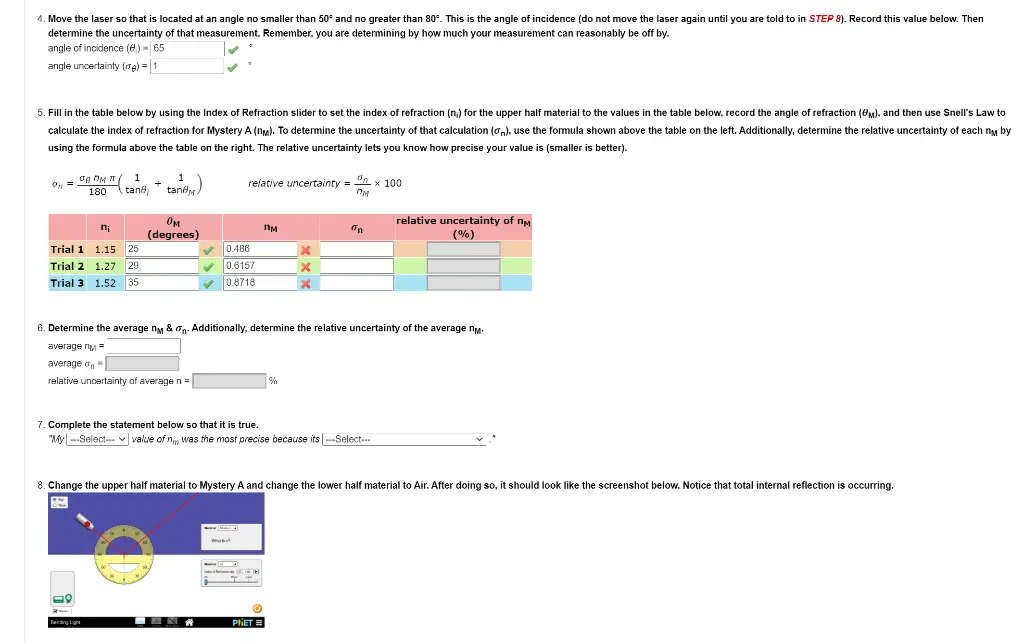
Transcribed Image Text:
4. Move the laser so that is located at an angle no smaller than 50° and no greater than 80°. This is the angle of incidence (do not move the laser again until you are told to in STEP 8). Record this value below. Then
determine the uncertainty of that measurement. Remember, you are determining by how much your measurement can reasonably be off by.
angle of incidence (6)-65
angle uncertainty (4)=1
5. Fill in the table below by using the Index of Refraction slider to set the index of refraction (n) for the upper half material to the values in the table below, record the angle of refraction (M), and then use Snell's Law to
calculate the index of refraction for Mystery A (nm). To determine the uncertainty of that calculation (σn), use the formula shown above the table on the left. Additionally, determine the relative uncertainty of each n by
using the formula above the table on the right. The relative uncertainty lets you know how precise your value is (smaller is better).
00 PM 1
180 tanė
1
tan@MA
relative uncertainty x 100
пм
ni
OM
(degrees)
ΠΜ
on
relative uncertainty of n
(%)
Trial 1 1.15 25
0.486
x
Trial 2 1.27 29
0.6157
x
Trial 3 1.52 35
0.8718
x
6. Determine the average nM & σn. Additionally, determine the relative uncertainty of the average ПM
average пм =
average on
relative uncertainty of average n =
%
7. Complete the statement below so that it is true.
"My ---Select---| value of n,, was the most precise because its |--Select---
8. Change the upper half material to Mystery A and change the lower half material to Air. After doing so, it should look like the screenshot below. Notice that total internal reflection is occurring.
Gending Light
PHET
9. For the table below, use the formula for Total Internal Reflection to predict what the critical angle will be. For this calculation, use the average n value you previously determined and the appropriate n value listed in the
table below. After doing so, set the index of refraction for the lower half material (nower) to the appropriate value listed in the table below. Then determine the critical angle by moving the laser and finding the smallest
angle (relative to the normal) at which no refraction occurs. This angle is the critical angle. Record it in the table below.
Prediction from
(degrees)
nlower formula for crit simulation for crit
Value from
(degrees)
Trial 1
Trial 2
1.11
1.4
Trial 3 1.49
Part B: Questions
1. The following statements deal with total internal reflection. Choose all the ones that are true.
One condition for total internal reflection is that the angle of incidence must be greater than the critical angle.
According to the formula sine, one condition for total internal reflection is that ny must be less na-
In the formula sinenr=
пр
ПА
Па
the smaller n is, the smaller Ocntis.
In the formula sine, the smaller ng is, the smaller crit is.
=
Па
2. The following statements deal with Snell's Law (the Law of Refraction). Choose all the ones that are true.
As the angle of incidence decreases, the angle of refraction increases.
When the angle of incidence is 0°, the light ray will stop moving as it refracts.
When going from a material with a high index of refraction to a material with a lower index of refraction, the light ray will bend away from the normal.
When going from a material with a low index of refraction to a material with a higher index of refraction, the light ray will bend toward the normal.
check_circle الجواب — حل مفصل خطوة بخطوة
hourglass_top
🔒
الحل الكامل متاح للمشتركين
اشترك في أرشيف الأسئلة لعرض هذا الحل وآلاف الحلول المفصلة خطوة بخطوة من معلمين معتمدين.